Happy Birthday TV

Happy Birthday TV

This week marks the 70th anniversary of the first television broadcast in Australia. This is important to me because I spent much of my early career working in the television industry.

It’s where I met my husband, who was also a film editor and made lots of excellent dramas including Brides of Christ which starred a very young Naomi Watts (bottom row centre), and an equally young Russell Crowe.
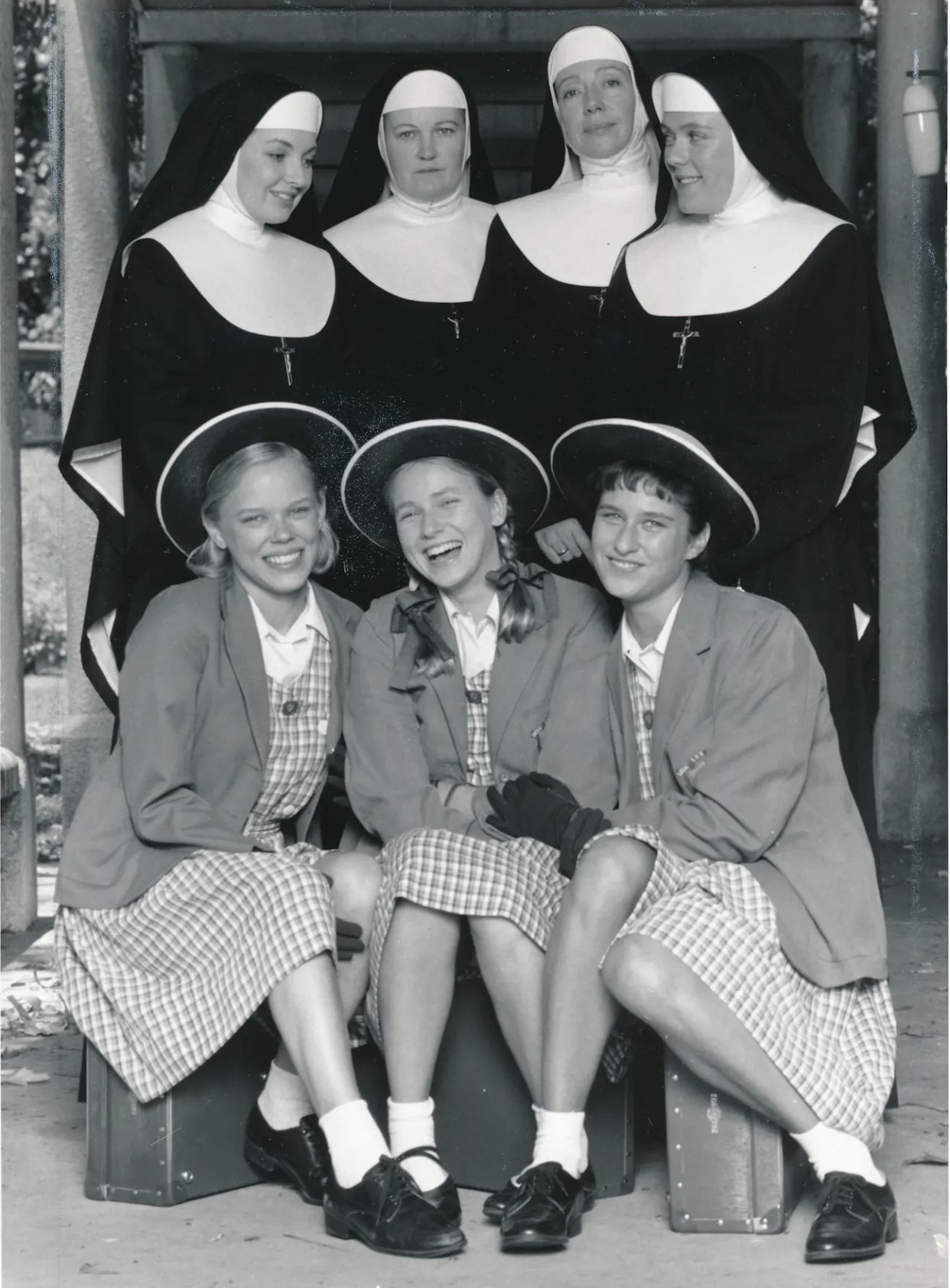
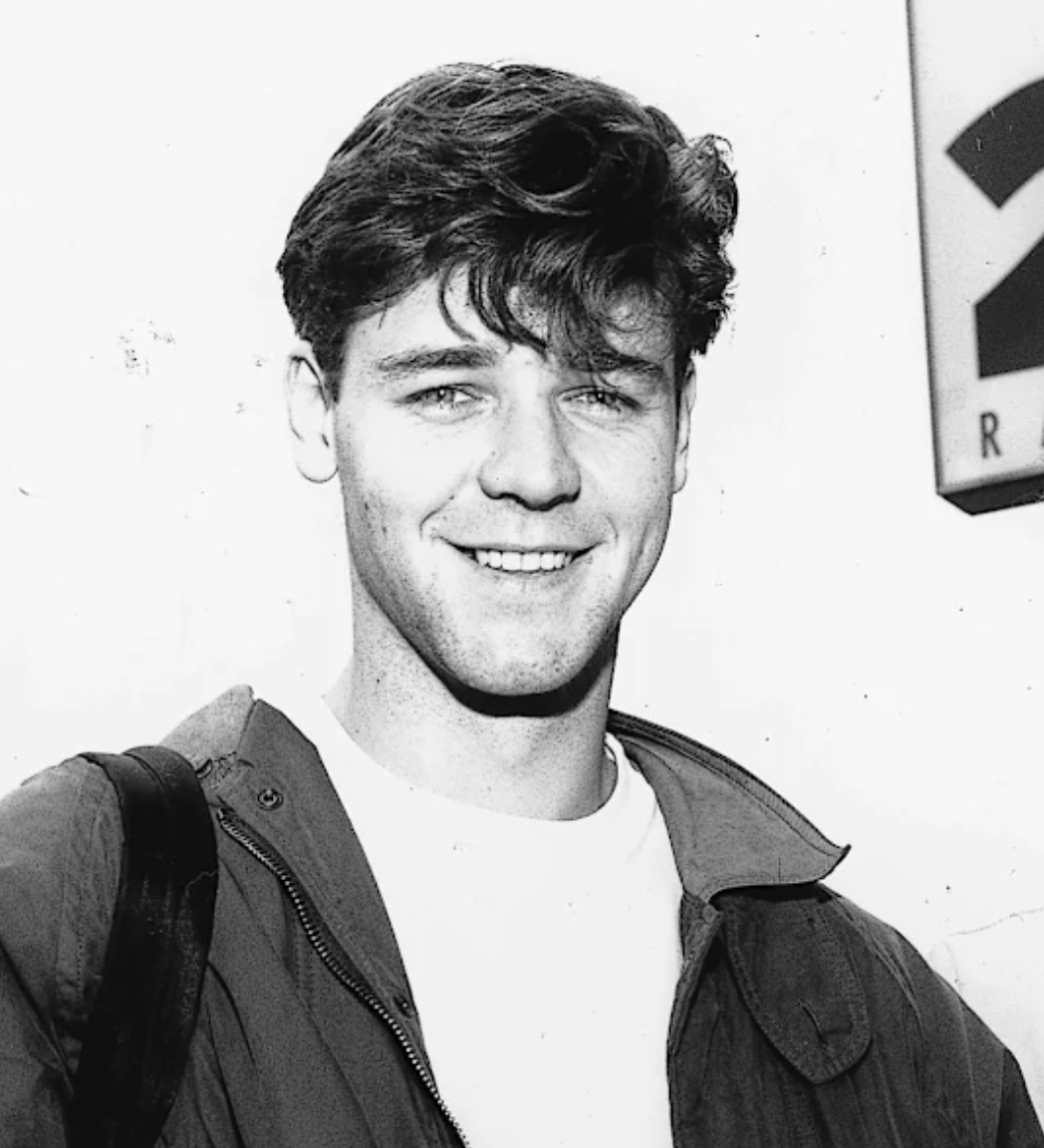
A recent article in the Sydney Morning Herald described the series as “Still the best six hours of television ever made”. You can find most of the series on YouTube.

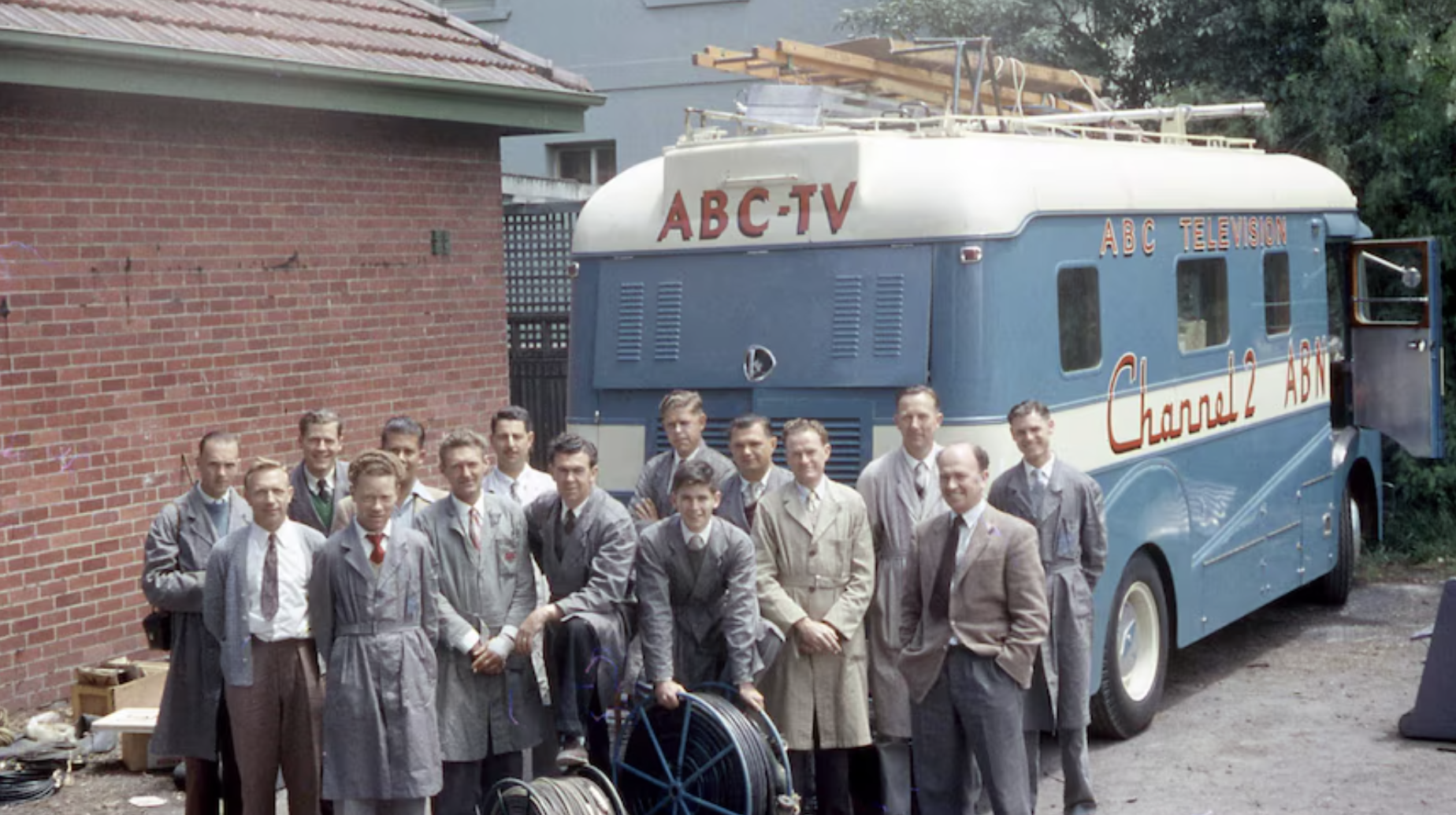
Tony’s dad, Pat Kavanagh, was one of the first camera operators in Australia and worked at the Olympic Games held in Melbourne in 1956. You can see him in the centre of this photo, leaning on his knee in a nonchalant way.
As a young child, we didn’t own a television set and would frequently stand outside the local electrical store watching the small black and white set through the window. On Sunday nights our mother would bathe and feed us and we would all toddle down the street in our pyjamas to watch Disneyland at our neighbours home. It was magical!

I came to work in the television industry in a roundabout way.

As a young person, I wanted desperately to be a sound technician. I loved music, but I wasn’t a very good musician, so I thought working in a recording studio would suit me. I also had ‘good ears’ and was interested in all things related to audio production. Unfortunately, there was only one recording studio in Perth, and they had no interest in hiring a 15-year-old with no training or experience, so I wrote to all the television stations and film production companies to see if I could find a job.

An offer came (by mail) from Channel Nine to work in telecine (where they put programs to air), but Channel Nine was out in the sticks and I didn’t have a car, so that was out of the question. Another small independent producer gave me a job as an editing assistant/typist/sandwich-getter, and I learnt a lot about film production and about being a working girl. To be honest, I spent most of my time alone in the office re-typing the same letter over and again. I was a terrible typist, and they were riddled with mistakes. I very much regretted not learning to type at school and this came back to haunt me when we purchased our first Apple computer.

In the early seventies I went to London and got a job as a photographic printer, again without much experience. It was impossible to get film work because the unions tightly controlled the industry, but in those days (the early 1970s) you could learn most things ‘on the job’ and I became quite good at photographic printing. My favourite task was printing copies of fine art collections. These prints were required for insurance purposes, so the colours had to be just right. I frequently went to see private collections in fancy homes so I could check the accuracy of my work.

When I returned to Australia in 1975, I got a job at the Australian Broadcasting Corporation, thanks to my friendship with Helena, who already worked there as a film editor. I started as a sound editing assistant and then moved to the documentary area where I worked on A Big Country (a long running series produced by the Rural Department). One of the highlights was working on Heartland, a series that documented changing attitudes to land use in Australia and included interviews with Permaculture’s Bill Mollison. It also included a detailed examination of bio-dynamic farming practices, so when a friend recently tried to explain everything she knew about burying cow horns full of manure, she was surprised to find I already knew about it. The series was awarded the Sir William McKell Award for Excellence in environmental journalism for film and television.

I feel very lucky to have had such an interesting and varied career. This is especially true given that I don’t see myself as terribly creative. Looking back at some references from my ABC days, I can see that perhaps I have misjudged myself. One reference mentions that I had a ‘meticulous attention to detail and creative flair in an often chaotic and heated environment’ and that made me feel proud, but mostly I feel fortunate to have worked with vibrant people bursting with great ideas.

Happy birthday television. It’s been fun!

Being creative

Lilya Brik shown editing film in 1928.
Lilya Brik shown editing film in 1928. (Photo credit: Wikipedia)

I have spent most of my working life doing the same sort of work in different settings. My first real job was as a photographic printer. I worked in a small studio for two groovy commercial photographers who did a range of advertising work. I was not only the printer, but also the delivery girl, receptionist and lunch getter. I may have even done the invoicing. I remember that one of the photographers spent most of his time in between jobs stripping down a rather large motorbike in the middle of the studio. It made a lot of mess.

I was queen of the darkroom on those days. I chose the best shots from a roll of film, developed and printed them and delivered the best of the best to the agency.  I was seventeen at the time. Later I worked in London as a colour printer. I had one client who was a big shot in the art world. He took photos of famous art works and my job was to reproduce these as colour prints that matched as closely as possible to the originals. One night we went to a famous private gallery after it had closed so that I could colour match the sample prints to the originals. It was a lot of fun.

My next job was in film editing. At the beginning there was not a lot of creativity or discretion, but as time went on I was able to make decisions about shots that worked and select music that brought things to life.

More recently I have worked as an educator, writer and presentation designer.

I have also done some training and coaching along the way, but despite my background, I persist with the idea that I am not terribly creative. Weird isn’t it? How many people get the chance to write and edit presentations and documents and get paid for it? What exactly does it take for someone to imagine themselves as a creative person?

Every day I hear people telling me that they can’t come up with ideas because they are ‘not creative’. If only they realised that the difference between a creative person and a ‘not very creative’ person is merely self-perception.

I know that my work has not been about coming up with original ideas for new films or books or web designs, but I honestly think that my decisions have been creative in their own small way. I think of myself as a backroom creative rather than one of those ‘out there’ types. More to the point, I think that it’s entirely possible that you are also quite a creative person and you’ve just undersold yourself.

I’ve been doing a little bit of an experiment at work. I’ve been pretending that I’m creative in an effort to see if the idea takes off. And amazingly it is! People have actually starting saying ‘you have lots of good ideas and that’s alright for you, but I’m not really that creative’. I find it hilarious. If only they knew that I’m not really that creative, I’m just pretending. The weird part is that the longer I pretend, the more prone I am to imagining that I am creative in my own little way.

If this strikes a chord with you, consider re-imagining yourself as a creative person.  I know that you probably feel a bit shy about commenting but I would really love to hear from you.

Design by Nature

Hello there everyone

I’ve been thinking a lot about Bev’s comment that nature has a lot to teach us so I thought I’d write a bit more about this today. I don’t want to get into a big theological discussion here, but I do think that designs in nature are truly amazing, especially the colour combinations that just magically work together.

I have recently discovered a lovely blog called Design Seeds. It’s based on a very simple idea – an interior designer posts images from nature alongside a colour palette. This means that if you like the look of an image, you can use the same colour scheme in your blog, website, presentation or brochure and it will look beautiful.  Here are a couple of examples. Beautiful aren’t they?

You can see more here: http://www.design-seeds.com/


After I discovered this site, I wondered if this was something I could do myself so I did some research and discovered this cool (and free) online tool called CSS Drive Image to Color Palette Generator 

You simply upload your own photo (less than 1mb and not wider than 1,000 pixels) and click on the generator and hey presto a colour palette appears like this:

Colour palette generator

It’s fun, have a go yourself.

Let me know if it works for you, it took me a few goes.

What I love most about this is that you don’t need to have any talent at choosing colours, you just need to know what you find attractive and that’s easy.

We all know what we like and don’t like, even if we can’t put it into words.


Not really that creative


HB graphite pencils Deutsch: Bleistifte der St...
HB graphite pencils Deutsch: Bleistifte der Stärke HB (Photo credit: Wikipedia)


When I am delivering my presentation design course a lot of people tell me that they would love to develop their design skills but that they are ‘not really that creative’. As I have mentioned before, I find this quite amusing as I am not really that creative myself. Some people are born with flair, but most of us have to work at developing their design skills. It certainly doesn’t come naturally to me.


About eighteen months ago I enrolled in a Bachelor of Graphic Design course so that I could develop my design skills. Since then I have struggled through the course, one subject at a time, and I must say it’s not talent or good results that makes me continue, just dogged perseverance and an unwillingness to give up or give in. I’m not sure if I am improving or becoming more creative, but I am learning a lot and I think that putting the principles into practice must surely pay off in the long run. At the rate I’m going, I’ll be studying for the next ten years or until I think I have a good enough grasp on the subject matter to forge ahead under my own steam.


What I have noticed since I started the course is that I’m a lot more tuned in to design. I notice colours and patterns. I appreciate beautiful packaging, I admire wine labels and linger over well designed websites. I see a lot more beauty around me and I think that’s a good thing.


I think one of the tricks to being creative is to develop an appreciation of what works and to be able to articulate why something works, rather than just liking it. My design course has helped me do that by introducing me to the rules and principles of the craft. Writing this blog has also provided me with the opportunity to share some of the things I’m learning about.


I would be very interested to know what you think about creativity. Do you have any thoughts on this topic or are there any topics that you think I should be writing about? I’d love to hear from you.