When a new person subscribes to Book Chat, I like to check out what other content they share on Substack. I think of it as audience research. It helps me understand what they are interested in, but I often feel sad when I see people who seem perpetually angry and outraged, sharing content that amplifies these feelings, rather than sharing anything uplifting or positive.
I worry about the mental health of people who are deeply engaged in the latest outrage cycle, whether it’s politics, AI doom-scrolling, or manufactured controversy. As an Australian, I’m particularly unmoved by American political drama, but the pattern is universal: people trapped in loops of indignation.
I rarely watch or listen to the news. I like knowing what’s happening in the world, but I can’t bear how the press sensationalises stories or presents only one side. Over the years, I’ve realised that constant exposure to negative news and political commentary only makes me angry and has no impact on the outcome.
I do believe in protest—both public and private—when it matters. But sharing outrage on a continuous loop isn’t good for you or your circle of friends. And every minute you spend on negative social media posts tells the algorithm you want more doom and gloom.
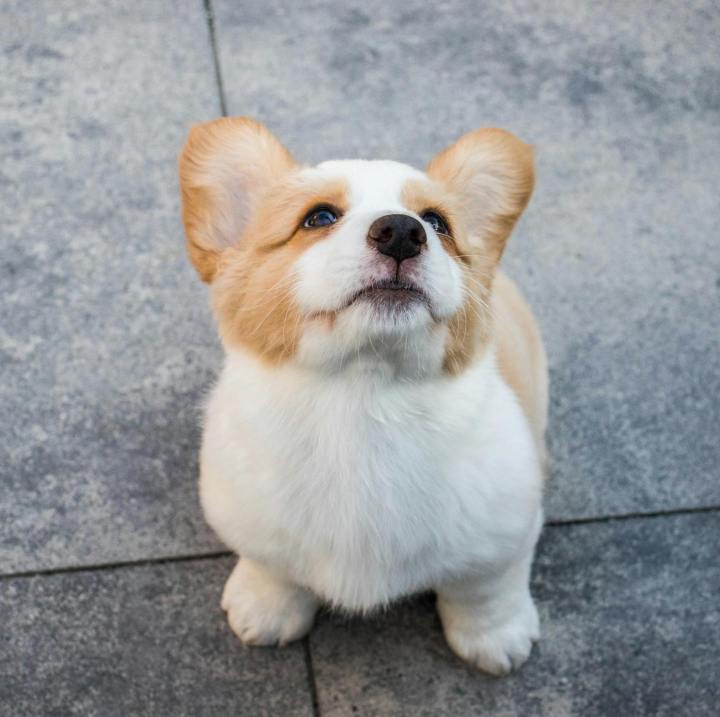
That’s why my feed is full of rabbits, cats, dogs, book recommendations, and recipes. I also get posts about cosy home renovations. Sometimes I even see updates from actual friends. I quite enjoy checking my social media feed because I’ve deliberately curated it to show me uplifting stories.
Research confirms that excessive bad news raises anxiety and cortisol levels and disrupts sleep. Covid proved this dramatically.
But what about genuine emergencies? Recently, the Central Coast experienced a devastating bushfire that destroyed 12 local homes. We were safe but concerned about friends and the wider community. In situations like this, staying informed is necessary—yet the constant news reports, sirens, and helicopters created intense unease.
Manage your exposure. Take frequent breaks from news and social media. Choose one reliable source and stick with it instead of channel-hopping.
Maintain basic self-care. Eat well and prioritise sleep.
Allow yourself to feel. Anxiety during crises is normal. Be kind to yourself.
Connect and contribute. Feeling helpless increases anxiety. Reach out to friends, check on neighbours, or ask someone how they’re doing. Small actions help.
Focus your mind. Practice mindfulness, meditation, or absorbing activities like crafting, cooking, or reading. Light entertainment works better than anything too demanding.
Listen to music. If your concentration skills are low, try listening to some soothing music or anything that makes you feel good.
The goal isn’t ignorance—it’s balance. Stay informed when it matters, but protect your mental health the rest of the time. Fill your feed with puppies and rabbits. You’ll be better for it.
In the early 1990s, I wrote a children’s book called Mr Nobody. It’s a small book, the kind your child might bring home from school in her backpack. Light and flexible, it was designed to be read as homework, or as a quick bedtime story. In Australia, we call these books ‘readers’.
Mr Nobody tells the story of Michael, a small boy of around five or six, who has an invisible friend who looks just like him. I based the story on my little brother’s imaginary friend. He was blamed for anything that went wrong in our house and was also a useful stand-in when my brother was scared or frightened. Mr Nobody never wanted to visit the dentist or have his hair cut.
I was ecstatic when I sold the manuscript for exactly $1000. It was a lot of money in those days, and it made me believe I had what it took to be a children’s author. Sadly, that dream was never realised. I wrote many other stories and articles, but publication eluded me, and I eventually lost heart, choosing to use my creative energy to write essays here on my blog, and then later in Book Chat, my newsletter for readers and eaters.
A few years ago, I was curious to see if my book was still in print, but I couldn’t find the ISBN (International Standard Book Number)) on the huge database which supposedly contains the unique number for every published book in the world. I assumed this meant my book was no longer in print, so thirty years later, I was very surprised to receive a message via social media from a woman in America.
She wanted to let me know her son had borrowed Mr Nobody from his school library.
Unfortunately, she wasn’t writing to tell me how much she loved it.
My child bought home your book Mr No Body (sic) from school. I found your title and your choice to describe a little black boy’s shadow as an ape extremely insensitive. As a well-established author, you are intelligent enough to know exactly why describing a black child’s shadow as an ape is overtly insulting.
Given your age and the generation you grew up in, I am very sure you know exactly why this was unnecessary. If you choose to include black illustrations in your children’s books, at least give us the same respect and dignity you give to others.
Do better.
I was absolutely devastated, but I was also pretty sure she was wrong. I would never have been so insensitive as to describe a black child’s shadow as an ape.
Just to be sure, I searched through my filing cabinet, found my copy of the book, and examined the front cover. Mr Nobody was an exact replica of Michael except that he was depicted as a shadow child. I felt vindicated. How could this woman have even imagined I would describe a small child as an ape? She must have misunderstood.
I wanted to send her a message to let her know she was wrong and that, more importantly, I had not had any say in the way the book was illustrated. Being a white person, I had imagined Michael as sandy haired boy who looked a lot like my brother, but I loved seeing him depicted as a little brown-skinned, curly-haired boy, resplendent in his dinosaur gumboots.
Most of all, I was thrilled that my book was still in print and that someone was describing me as a well-established author, although it made me feel bad that I wasn’t, as if I hadn’t been trying hard enough.
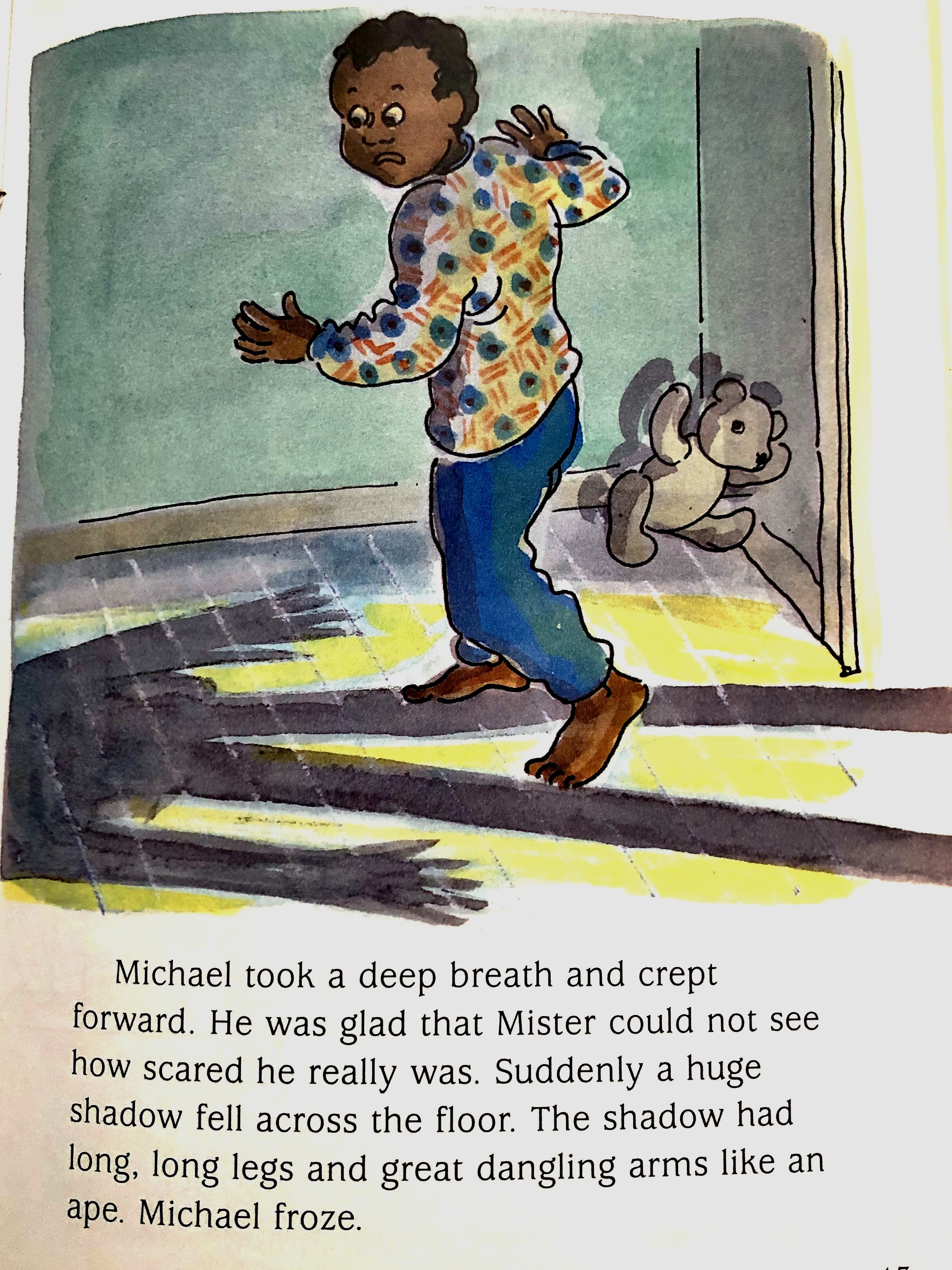
I was still very sure that she had made a mistake, but I went back and read the whole book just in case there was any chance that I had missed something. There’s a scene where Michael is in bed and imagines there’s a monster in the wardrobe. (Spoiler alert – it’s his dog). Michael gets up to investigate while Mister hides under the bedclothes.
“Michael took a deep breath and crept forward. He was glad that Mister could not see how scared he really was. Suddenly a huge shadow fell across the floor. The shadow had long, long legs and great dangling arms like an ape. Michael froze.
‘What are you doing out of bed?’ asked Michael’s dad as he switched on the light. The shadow disappeared.”
Good heavens! I hadn’t described Michael’s shadow as an ape, but I had described his dad’s shadow as an ape, which is equally appalling.
I was surprised and ashamed. I would never have imagined a scenario where I could be accused of racism, and that it would be totally justified.
In 2015 there was a huge furore in Australia when a 13-year-old girl at a football match called one of the players an ape. Adam Goodes, a football star and proud Indigenous man, pointed to the girl and asked for her to be removed from the stadium by security. He later explained to the girl why calling a black person an ape was insulting, and she begrudgingly apologised.
Speaking about the incident later, Goodes said he was absolutely gutted by the insult and felt like he was back at school, where he was frequently the victim of abuse.
But the girl’s mother, who chose to remain anonymous, claimed that he had ‘overreacted’ and that her daughter was traumatised by the event. She said Goodes “shouldn’t take things to heart as much as he does” and that being “badgered” on the football field was part of being a football player.
A media storm resulted. Many people in the community thought that Goodes was being too sensitive, and fans began to boo him incessantly when he took the field. It was clear that many people were unwilling or unable to understand that racism is baked into Australian culture and that racist slurs exist, intentional or otherwise.
Despite support from many people in the community, Goodes took leave from the game he loved and eventually retired from football. He subsequently created The Adam Goodes Foundation, which provides educational opportunities for Indigenous youth and is widely respected in the community.
As the arguments in the media raged on, I counted myself firmly on the side of Adam Goodes, believing that no one, not even a child, has the right to call someone a monkey.
And all that time, I was accidentally sitting in the same camp as people I detested. An accidental racist with nowhere to hide.
To make matters worse, I took the coward’s way out and did not reply to my letter writer.
I could have made excuses for myself. I could have explained that things were different in 1994 and (white) people were not as aware of racial slurs, but I don’t really think that’s true. I think they just didn’t care, and the rest of us just let them get away with it.
I could say that things have changed, but what would I know? I’m fully aware that my life as a middle-class white woman give me practically no insight into what it means to live in the world as a black person.
Over the years I have tried to educate myself by listening to black voices, but I failed to do the one thing I could have done and just said ‘sorry’.
I’m also sad that I can no longer look at my book and feel proud that it made it into the world. It’s still a lovely book with a nice ending, but it feels slightly tarnished.
But mostly I’m sorry that somewhere in the world I made a little boy, and his mum, feel sad and angry.
I guess it’s never too late to apologise, and perhaps I should do just that.
If you enjoyed this post, you might like Book Chat—my fortnightly newsletter where I share book recommendations and simple recipes.
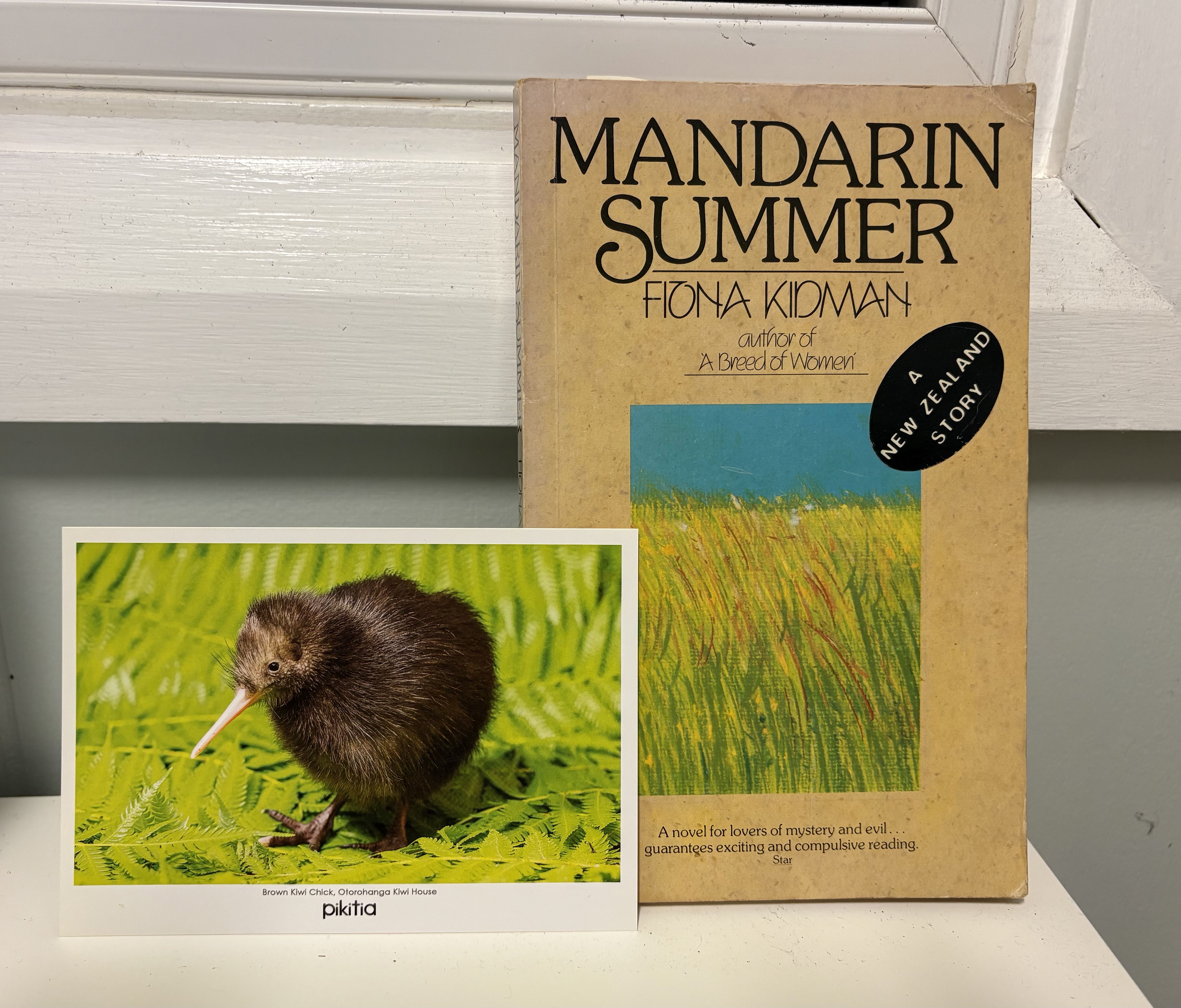
Back in the 1980s, when I was working as a film editor at the Australian Broadcasting Corporation, I read a book called Mandarin Summer by the New Zealand author Fiona Kidman.
It’s a coming-of-age story – also called a Bildungsromanin the literary world. If you’re unfamiliar with this term, it literally means ‘a novel of education’, because it tells the story of a character’s formative years. Some well-known examples of this genre include Jane Eyre (1847) by Charlotte Brontë, and The Hunger Games (2008) by Suzanne Collins. Both books feature young protagonists who are about to discover what the real world is all about.
I love books which focus on transformation, and I particularly like coming-of-age stories which feature young women on the cusp of adulthood. They’re not easy to write because the author needs to accurately capture a voice which is sometimes childish, and at other times more worldly.
Set in 1946, Mandarin Summer tells the story of eleven-year-old Emily Freeman, who moves to the Northland of New Zealand with her parents after her father returns from the war. Luke and Constance have purchased a plot of land from the Barnsley family, but when they arrive, they discover the land they have purchased is useless.
During the drought-stricken summer that follows, Emily and her family become embroiled with the Barnsley family, and family secrets are forced into the open. The novel builds to an explosive and satisfying climax, slightly reminiscent of Jane Eyre in that it involves a fire.
When I first read Mandarin Summer, I was captivated by the writing, which is spectacularly filmic. I talked about the book so much that the film director I was working with suggested I purchase an ‘option’ on the rights. Matthew, the director, was a very entrepreneurial Irishman who had made several independent films, and he convinced me that purchasing an option was a great idea, even though I had no experience in being a film producer.
It was very cheap to do this, perhaps only a couple of hundred dollars for a period of around two years. Optioning a book gives the producer (in this case me) time to develop the script and approach funders. During this time, the author cannot grant anyone else a similar option and the producer pays a small fee for the privilege.
Sadly, my real life took over and in the end my option lapsed without me doing any of the required work. I could have renewed it, but it seemed unlikely I would ever get around to doing anything with it. In retrospect, I cannot imagine why I ever thought I would be able to attract backers for a movie, I only knew that the book was extremely visual and would make a great film.
What was strange about the whole situation was that at the time, I didn’t even own a copy of the book!
I’d originally read a library copy (of course) and couldn’t track down another copy. So when we visited Auckland a few years ago, I was delighted to find an old, yellowed copy in a second-hand bookshop and I snapped it up for old-time’s sake. It still sits on my shelf as a reminder of when I had big dreams about doing big things. Inside the book is a faded postcard of a baby Kiwi, a little chap who probably also had big dreams.
I was delighted to discover that Mandarin Summer is still in print, even though it was never made into a film, as far as I know. It was republished in 2021, and I’m pleased to say that the author, now known as Dame Fiona Kidman, is still writing books and poetry and is a leading figure in the New Zealand book industry. She’s 85 and still going strong.
If you’d like to read my review of a recent ‘coming-of-age’ book, also set in New Zealand, check out BOOK CHAT, my newsletter for readers and eaters.
I got a fake email this morning telling me that I needed to buy more iCloud storage space. I knew it was fake because:
I purchased some extra storage space about three weeks ago, so I should have plenty.
The email address looked very suspicious.
The price was wrong. I know exactly how much extra storage costs.
But the sentiment did make me laugh. Has my brain reached its storage limit, and if so, what am I going to do about it?
Like my wardrobe, my brain is absolutely full of useless information I don’t want or need. It needs a really good clean out.
This morning I was trying to remember the name of the elderly man who used to live next door. Neither my husband nor I could recall his first name, but eventually we realised this was because we always called him Mr Perkins. He was a lovely old gentleman, but his wife was a horrible old bag who could sing like an angel but was otherwise awful. She used to give him a list of jobs every day and then berate him at the end of the day if he didn’t complete them all to her satisfaction.
One day she simply disappeared. We thought maybe he had murdered her and buried her in the back yard but were too nervous to ask. It transpired that she had gone to live in Tasmania. We were very happy to hear this for a variety of reasons, not least because it meant we didn’t live next door to a murderer. One day she came back, moved him into a retirement village and sold the house. He didn’t seem to have much say in the matter and we were sad for him.
Although I couldn’t initially recall the name of Mr Perkins, I knew it was in my brain somewhere, along with the name of my third-grade teacher (Mrs Robertson), and the number of hearts an octopus has (three).
I also struggle to remember my husband’s mobile phone number. I always have to look it up. I worry that I will be in an accident one day and the ambulance people will ask me for his contact details, and I will just have to shrug and admit I don’t know. I know it starts with 0418 and ends with 918 but I can never remember what’s in the middle. When I say, “what’s your mobile number again?” he always looks at me strangely. I have saved it in my phone under his name and under ICE which apparently stands for ‘In Case of Emergency’. Perhaps I should also save it under ‘husband’?
I don’t think there’s a good way of clearing out my brain, but I do know that getting adequate sleep is important. I haven’t been sleeping very well lately, and after a night of tossing and turning, I’m very conscious that concentrating and remembering are noticeably more difficult.
Lately I’ve started carrying a notepad and jotting down things I want to remember. I keep a record of films I’d like to see, wines I’d like to try, and most importantly, books I’d like to read. I also use the notes function on my phone to jot down all of the above, plus ideas for articles or things I find funny or interesting.
On the whole, I try not to stress about forgetting things. I met a woman recently who said (quite cheerfully) “Oh, I remember nothing” and I thought her attitude was a lot better than constantly worrying and apologising for not remembering.
A friend told me she was trying to read Wuthering Heights but was finding it hard going. I was curious about why she was persevering if it wasn’t her thing. Regular readers know my stance on reading books you aren’t enjoying, but I also understand that people often feel embarrassed if they haven’t read books they think everyone else has, especially if they are classics.
I’m reminded of a scene in a movie where the main character reads Democracy in America (by Alexis de Tocqueville) because she thinks everyone has read it and she feels inferior. It’s only when she’s finished grinding her way through the enormous book and tries to discuss it with her new friends that she finds out no-one else has actually read it. They’re all just pretending and no-one has ever found them out.
And that’s the truth of it. Many people haven’t read Dickens, the Brontës or Jane Austen, and this doesn’t make them any less of a reader, or a person for that matter. My friend definitely doesn’t need to think she doesn’t measure up because she hasn’t read certain books.
To be perfectly honest, I’ve never read Wuthering Heights, but I have seen the movie and the characters always drive me crazy. There are just so dramatic and make totally stupid decisions.
Where to begin?
There’s something to be said for having a crack at something more challenging, but you need to choose carefully. Victorian literature is dense and wordy, so you may need to find a quiet place to really get into the story.
If you’re keen to read one of the classics, but don’t know where to start, I would try Jane Eyre by Charlotte Brontë. It’s a cracking story about an orphan who endures a miserable childhood, then as a young woman gets sent to work in the home of the wealthy and impetuous Edward Rochester. First published in 1847 under the name of Currer Bell, Jane Eyre is a bildungsroman (a coming of age story) that deals with class, sexuality and religion, but it’s also a wonderful love story with a satisfying ending. Along with Pride and Prejudice, and Gone with the Wind, it’s one of the most famous love stories of all time.
The Tenant of Wildfell Hall
Another book I enjoyed is The Tenant of Wildfell Hall by Anne Brontë. Published in 1848 under the name of Acton Bell, it remains remarkably relevant today with its strong feminist themes and portrayal of a woman escaping domestic abuse.
Helen Graham is a beautiful and secretive young woman. She moves into Wildfell Hall with her young son and the locals are desperate to know more about her. A man named Gilbert Markham offers Helen his friendship, but as local gossip and speculation surround her reclusive behavior continue, he wonders if he has misplaced his trust in her.
The shocking details of the disastrous marriage she has left behind emerge when she allows Gilbert to read her diary…
‘A powerful novel of expectation, love, oppression, sin, religion and betrayal’.
Daily Mail
The Tenant of Wildfell Hall
Middlemarch
A third suggestion is Middlemarch by George Eliot (Mary Ann Evans). It’s a very long book and was originally published in eight instalments. Set in a fictitious town in England in the early 19th century, it tells the story of Dorothea, an intelligent, earnest woman who makes the mistake of marrying Edward Causabon, a man many years her senior. He’s a pompous scholar and bore and his main reason for marrying is to use Dorothea as his personal secretary. Dorothea promptly falls in love with Will Ladislaw, Edward’s idealistic cousin, but tries to remain faithful to her husband, even after his death (silly woman).
I read it many years ago and loved it, but if you really don’t think you can make it through such a long book, look out for TV series (made in 1994) which stars a young and very handsome Rufus Sewell as Will Ladislaw, and Juliet Aubrey as Dorothea.
Why did they use pen-names?
All three novels were published under male pseudonyms, a common practice in Victorian times. Some women wanted to be able to write more freely, others wanted to be taken more seriously. In the case of Eliot, its been suggested that she avoided using her own name because of her elopement with journalist and critic George Henry Lewes, a married man with whom she lived happily for many years.
According to this article, Eliot “relished being thought of as a male and was disappointed when people thought otherwise.” Until Eliot’s first mass publication, The Sad Fortunes of the Reverend Amos Barton in 1957, George Eliot was thought to be male. Eliot was outed in 1958 by a widely circulated letter written by Charles Dickens, who pointed out that the piece was too feminine to be written by a male.
Following Lewe’s death in 1878, Eliot subsequently married her accountant, John Cross and was criticised for this as well. She just couldn’t win!
Want more reading recommendations?
Sign up for Book Chat, a newsletter for readers and eaters.
In the latest issue of Book Chat, I wrote about my habit of reading cookbooks when I’m stressed or anxious. I find it calming to flick through the recipes, admiring the photos and reading the stories.
For me, reading a cookbook is not just about looking for new recipes, although that’s part of it. It’s more about getting off the computer, getting away from the news, and simply curling up in bed with a cup of tea and no real purpose. It’s the ultimate in self-care.
As a lover of cake, I’m particularly drawn to books about baking. They have the best, drool-worthy pictures. But I also like vegetarian cookbooks and international cookbooks.
I might end up trying a recipe if it’s easy and I have the ingredients at hand, but mostly I read cookbooks because they let me imagine that I’m a different, more adventurous kind of person. More sociable, more organised. More like my best self.
Cookbooks offer a vision of who you might be if only you had the energy to apply yourself, but they do it in a way that is gently encouraging. They don’t challenge or confront you. They just offer a peek into another world.
Reading A Table for Friendsby Skye McAlpine allows me to daydream about being the kind of person who could host the perfect dinner party without getting stressed.
Let’s be honest, I’ve never hosted a proper dinner party, but I think that if I did, I would find it quite stressful. The most I’ve ever attempted is inviting a couple of friends over for dinner, which doesn’t quite qualify in my book. In my mind, a dinner party involves candles, fancy clothes and fancy foods. Think soufflés and chocolate mousse! I’ve cooked for family events, birthdays and Christmases, but that’s more like an exercise in logistics rather than organising something elegant. Mostly it’s just a case of buying enough food and having a variety of dishes, so everyone is happy.
Love is a Pink Cakeby Clare Ptak encourages me to believe that one day I will learn to decorate a cake to perfection, or assemble the perfect Swiss Roll. My usual method of decorating a cake is to plonk a bunch of fresh flowers on top, and mostly it works well, but I admire people who can decorate a cake with skill and artistry and I love to think that one day that could be me.
Around the Tableby Julia Busuttil Nishimura, reminds me I should really get around to buying some lovely linen tablecloths with contrasting napkins and then I could be a smiley person with a lovely tidy home. I know the photos in these books are staged, but still, they are gorgeously attractive and appealing. Unfortunately, I also have a thrifty streak and I cannot bear to throw away all my perfectly good tablecloths and cutlery, even if they have seen better days.
I imagine I will just stay the way I am, and that’s okay. A person can dream.
In modern society we put a lot of emphasis on persevering and seeing things through to the bitter end, but this shouldn’t apply to books.
There are some things in life we should do, even if we aren’t enjoying the experience. Eating vegetables, cleaning your teeth, and doing some exercise now and then are all things that are good for us. But finishing a book is neither good nor bad. It’s not a reflection of your character if you choose not to finish a book.
People often tell me they always finish books—they’re known as completists—but I’ve never been able to get them to articulate why they think it’s so important. My guess is that they think there is something honourable about finishing something once they’ve started. They probably don’t have any half-finished knitting projects in the back of the cupboard either!
Good for them, but I prefer to make my reading time count. I agree there’s value in doing activities that require effort and self-discipline, but that doesn’t apply to reading unless you are studying or reading for work. If you’re reading for pleasure, it shouldn’t be a chore. There’s no gold star for finishing a book you aren’t actually enjoying.
I was talking to a friend about this, and she said she often keeps reading because she’s a hopeful person and she likes to think the book will get better. I admire her attitude and agree that you need to give a book a fair chance, but I can usually tell after the first few pages whether a book is for me. I’m getting better at choosing as I get older, but I’m also more ruthless and less likely to spend time on books that aren’t for me.
Sometimes I speed read to the end so I can find out what happens, but often I just stop reading and take it back to the library. I never feel guilty and I’m prepared to accept the possibility that I might miss out on a gem. It will be there in the library if I feel like reading it some other time.
People often talk about abandoning books, which makes them sound oddly like children they no longer care for. But books don’t have feelings and the author will never know you didn’t make it to the end if you keep your mouth shut and don’t start posting negative reviews on Goodreads. Writing a book is hard and just because you didn’t love it doesn’t mean it won’t be perfect for someone else. If we all loved the same books, the world would be a very boring place.
I’m happy to discuss the merits of certain books with my sisters and a few close friends (we can be harsh critics), but I only ever recommend books I like in BOOK CHAT, my newsletter for readers and eaters. I once heard Anne Bogle (book recommender) say she stopped mentioning books she didn’t like because people would often recall the title but forget what she had said about it. They’d see it in a bookshop, buy it, and then message her to say they were disappointed. So when I started my newsletter, I adopted the same approach. I figured my subscribers didn’t need to know what books I hadn’t enjoyed. I read about 50 books a year, but only half of them make it into BOOK CHAT.
I also know that we don’t always ‘enjoy’ books. Some books are hard going and confronting but they open our eyes to other worlds and other people’s experiences. If a book makes you feel uncomfortable, but is well-written, honest and true, then maybe you should keep reading so you don’t exist in a bubble. But if a book is poorly written, with thin one-dimensional characters and a silly plot, or if it bores you, put it down and pick up another. There are literally millions of excellent books in the world, and you only have a limited amount of time.
It’s okay to choose wisely. Read for pleasure, information or inspiration, but don’t make it a chore.
Anne of Green Gables by L. M. Montgomery was an immediate success following its publication in 1908. Set on Prince Edward Island, it tells the story of Anne Shirley, a young orphan with striking red hair, a wild imagination, and a strong sense of justice.
When Anne first arrives at Green Gables, she asks her new parents if they can spell her name with an ‘E’ because she doesn’t want to be just plain Ann.
I understand how she feels. We all want to imagine we are special.
By coincidence, my middle name is also Anne, but opinions on exactly how to spell it have differed over the years.
Born in 1956, I was the third daughter of Leslie and Nola. My two older sisters were given three syllable first names followed by three letter second names – Beverley Joy and Jennifer Lee – so my name needed to comply with the same, somewhat arbitrary, rules. My mother wanted to name me Meredith, but I ended up being christened Margaret Ann.
Just plain Ann. No airs or graces. And this is the spelling I used throughout primary and high school. It’s on all my official documents, including my baptismal certificate, school reports, and swimming certificates.
It wasn’t until I turned 17 and applied for a passport that I found that my middle name was spelt with an ‘E’, just like Anne of Green Gables. It was right there in black and white on the full copy of my birth certificate. No-one had ever noticed the incorrect spelling and I suppose it didn’t really matter to anyone else, but I took it personally. It signalled I was less important than my siblings.
When I raised it with my mother, she explained that because she was busy with three young children, an uncle had been despatched to the registry office to submit the paperwork. I don’t suppose she ever actually looked at the birth certificate.
I started adding an E to my name, but she always spelt it her own way. When we went overseas, we had to fill out a passenger information form and she insisted I had used the wrong spelling. I could not convince her I had to use the version on my birth certificate and passport.
The misspelling of my name was accidental, but it compounded the other ‘evidence’ I had collected to prove that I mattered less than my siblings.
Chief exhibits were my christening mug, which is inscribed with the wrong date of birth, and a baby photo with a note in my mother’s scrawled handwriting: 1956 – not sure who the baby is? She’s holding the baby, and it’s very obviously me. How many babies did she have in 1956?
I badgered her about this for years, trying to make her feel bad by suggesting that I was less valued than my siblings, which was blatantly untrue. She was just a busy mum with three kids and a sick husband.
But I still feel for Anne when she says she wants to be special. She’s desperate to make an impact on the world and it all starts with being seen as someone who’s different and less ordinary.
A friend asked me recently why I wasn’t doing any writing and it surprised me because I’ve been writing regularly, just not here.
I assumed (wrongly) that regular readers would subscribe to my newsletter (Book Chat) even though I only ever mentioned it once, possibly in passing. It was foolish of me to think that people would rush to sign up for something new when I hadn’t taken the time to explain what it was all about, so I thought I would do that today.
Let’s start with the first question I usually get asked:
Why do you have a blog and a newsletter and are they the same?
The answer is no, not really.
Book Chat (my newsletter) is very short and contains reading recommendations and simple recipes. I started writing it about two years ago (during lockdown) and since then I’ve sent it out every two weeks without fail. The newsletter focuses on helping people find something good to read because, despite the plethora of books being published every year, it can be challenging to find a really great read. I’m mindful that we all have different tastes, but people often ask me what I’m reading and I love sharing recommendations, so this feels like a useful thing to do.
There’s an archive of past newsletters if you’d like to check out some of my recent recommendations.
I also launched an online book club this year, and it’s turning out to be a fun activity, despite me being quite nervous about hosting an online session. I don’t know why I was nervous because I love talking about books and everyone was lovely. The Book Chat book club meets four times a year and the next book is Matt Haig’s, The Midnight Library. You are very welcome to join in and it’s free for subscribers.
The newsletter has recipes because I also like food! I think that good books and good food go together naturally and people seem to love recipes, if only to remind them to make an old favourite they’ve forgotten about.
It’s been satisfying to see a steady growth in subscribers over the past two years, but in the meantime, I’ve neglected this blog. I haven’t posted anything new here since last October and that seems like eons ago.
This blog remains a space where I can explore topics in more depth. The posts are short essays that are often (but not always) book-related. I like to use my reading as a springboard for articles about issues that interest me. Some of my favourite posts in this vein include The Man Who Didn’t Wash His Dishes and Sunshine on My Shoulders.
I also write personal essays. Plenty is about growing up in the Salvation Army and absorbing ideas about self-denial and Family Secrets is about trying to find out whether my grandfather was a bigamist. There’s a lot more variety here because I have the freedom to write about whatever I like, so I’d encourage you to explore the website. I’ve been blogging here for ten years, so hopefully you’ll find something that resonates with you.
This year I planned to send some articles out for publication, but the thought of that often seems overwhelming, so I plan to post here more regularly, whilst I figure when and where to send my work.
Whether you subscribe to this blog, or my newsletter or both, I appreciate you all. Thanks for being here and reading my words.
A friend was bemoaning the fact that some books are disappointing despite having glowing reviews on Amazon and Goodreads (owned by the same company, in case you weren’t aware).
It’s hard to judge a book solely on the comments of other readers, especially if you don’t know their reading tastes, and they don’t know yours. Nevertheless, we are often influenced by five-star reviews.
If you’re anything like me, you can’t help wanting to get your hands on books that are getting lots of press and are thrilled when you see a much-hyped new release sitting on the ‘new books’ shelf at the library. You take it home full of expectation, only to find it’s not as good as the hype suggested. It’s so disappointing. What were they thinking giving it five stars? You’d only give it three, and that’s being generous.
There are many reasons books get lots of hype. A book can be genuinely brilliant and deserve all the press (Lessons in Chemistry), or win a prestigious prize (Shuggie Bain), or have a huge publicity budget (Jane Harper). The lead time for a new book is very long, at least a couple of years. During that time, many industry pundits have read advanced review copies (ARCs). Copies of new (unpublished) books are also available from NetGalley, so anyone who wants to make a living as a reviewer or book influencer can log in to read digital copies well before they hit the shelves. And a free copy of a book often equals a positive review, unless you are writing for Kirkus.
A book may not be right for you for many reasons. I snaffled a copy of Carrie Soto is Back (by Taylor Jenkins Reid) at the library last week and only read the first few pages before putting it in my return pile. I’m sure it’s probably an excellent book, but I’m not that interested in tennis or any sports really, so it didn’t gel with me.
It rarely takes long to figure out if a book is for you. With most books, you only need to read the first couple of pages to know that you are going to enjoy it. Others take a while to get going, so you need to read a few chapters before you can really commit. I’ve heard people say you should read seventy pages, but I can usually tell much more quickly.
People are often tell me they always finish books, even if they aren’t enjoying them. This is madness! You should never keep reading a book you aren’t enjoying (once you’ve given it a decent chance, of course). There are so many books out there, just read what makes you happy. If you feel bad about not finishing books you’ve purchased, give them to a little street library so they can find a new home. If they are library books, take them back to the library as quickly as you can so another reader can enjoy them. Don’t keep them by your bedside for weeks and weeks, feeling guilty about not reading them.
I’m getting better at choosing books, but my secret is that I nearly always pre-read the first chapter on my iPad. I have literally hundreds of sample chapters which I browse through regularly. I’m constantly adding new titles when I see interesting books advertised or reviewed, and I subscribe to many newsletters from writerly people and publishing houses. I’m lucky enough to have a circle of bookish friends, so I get to talk about books a lot, and I belong to a family of readers which is very handy. I trust their judgement, but most of all I’m confident they know my reading tastes (and quirks) and will recommend books I’ll probably enjoy.
It might not be the same for you. You might not have the time or inclination to spend hours and hours hunting down new titles, or you might be in that weird situation where there are lots of options, but nothing seems quite right. To be honest, that’s why I started Book Chat (a newsletter for readers). I like to think that by reading widely, I can help people narrow down their options and make choosing easier. I know not everyone has the same reading tastes (thank goodness or the world would be a boring place) but I hope that by providing reliable recommendations you can find a book that’s just right for you.
If you would like some reading recommendations, why not subscribe? If you’re already onboard, thank you.





 Margaret Moon