
Back in the 1980s, when I was working as a film editor at the Australian Broadcasting Corporation, I read a book called Mandarin Summer by the New Zealand author Fiona Kidman.
It’s a coming-of-age story – also called a Bildungsroman in the literary world. If you’re unfamiliar with this term, it literally means ‘a novel of education’, because it tells the story of a character’s formative years. Some well-known examples of this genre include Jane Eyre (1847) by Charlotte Brontë, and The Hunger Games (2008) by Suzanne Collins. Both books feature young protagonists who are about to discover what the real world is all about.
I love books which focus on transformation, and I particularly like coming-of-age stories which feature young women on the cusp of adulthood. They’re not easy to write because the author needs to accurately capture a voice which is sometimes childish, and at other times more worldly.
Set in 1946, Mandarin Summer tells the story of eleven-year-old Emily Freeman, who moves to the Northland of New Zealand with her parents after her father returns from the war. Luke and Constance have purchased a plot of land from the Barnsley family, but when they arrive, they discover the land they have purchased is useless.
During the drought-stricken summer that follows, Emily and her family become embroiled with the Barnsley family, and family secrets are forced into the open. The novel builds to an explosive and satisfying climax, slightly reminiscent of Jane Eyre in that it involves a fire.
When I first read Mandarin Summer, I was captivated by the writing, which is spectacularly filmic. I talked about the book so much that the film director I was working with suggested I purchase an ‘option’ on the rights. Matthew, the director, was a very entrepreneurial Irishman who had made several independent films, and he convinced me that purchasing an option was a great idea, even though I had no experience in being a film producer.
It was very cheap to do this, perhaps only a couple of hundred dollars for a period of around two years. Optioning a book gives the producer (in this case me) time to develop the script and approach funders. During this time, the author cannot grant anyone else a similar option and the producer pays a small fee for the privilege.
Sadly, my real life took over and in the end my option lapsed without me doing any of the required work. I could have renewed it, but it seemed unlikely I would ever get around to doing anything with it. In retrospect, I cannot imagine why I ever thought I would be able to attract backers for a movie, I only knew that the book was extremely visual and would make a great film.
What was strange about the whole situation was that at the time, I didn’t even own a copy of the book!
I’d originally read a library copy (of course) and couldn’t track down another copy. So when we visited Auckland a few years ago, I was delighted to find an old, yellowed copy in a second-hand bookshop and I snapped it up for old-time’s sake. It still sits on my shelf as a reminder of when I had big dreams about doing big things. Inside the book is a faded postcard of a baby Kiwi, a little chap who probably also had big dreams.
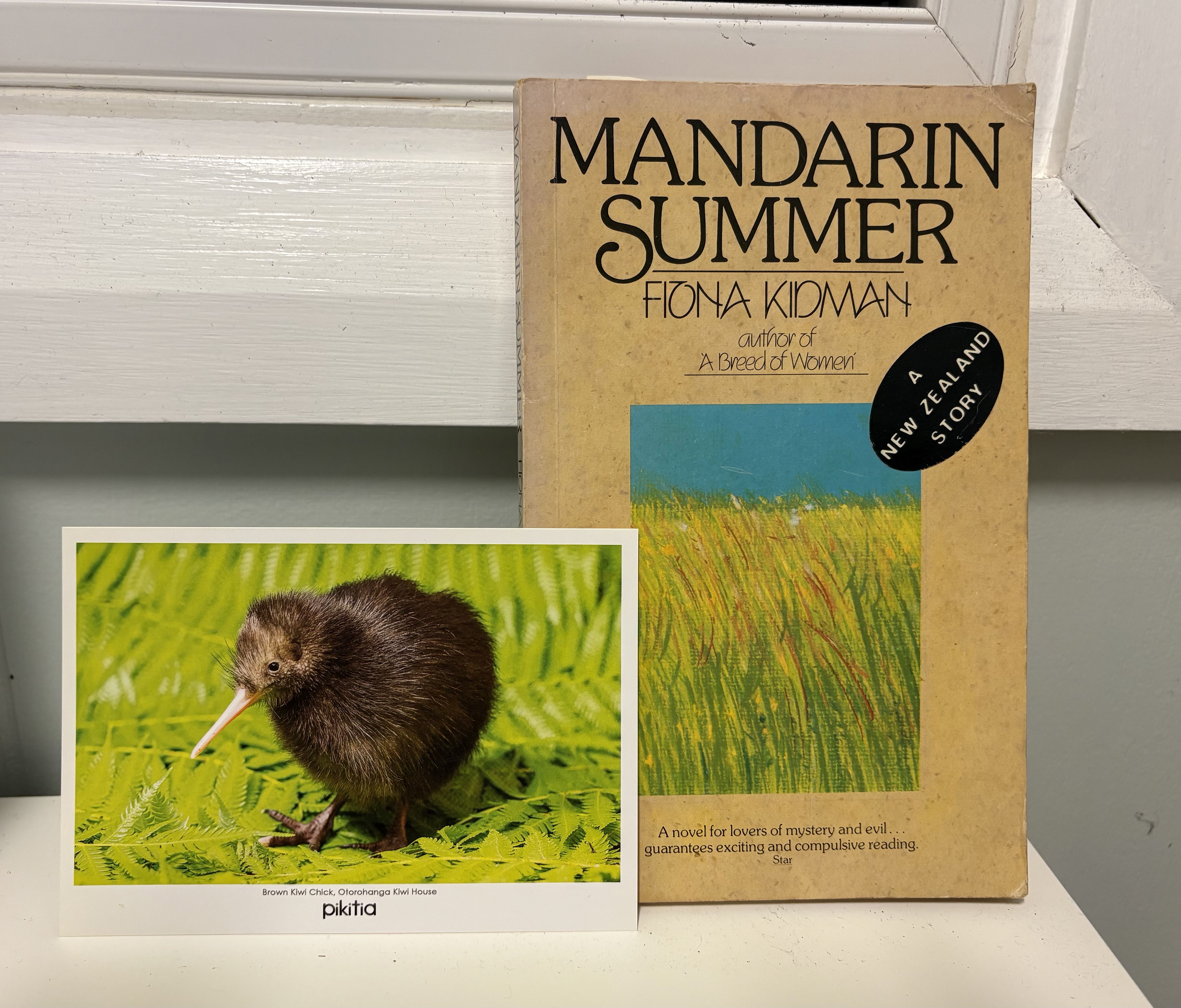
I was delighted to discover that Mandarin Summer is still in print, even though it was never made into a film, as far as I know. It was republished in 2021, and I’m pleased to say that the author, now known as Dame Fiona Kidman, is still writing books and poetry and is a leading figure in the New Zealand book industry. She’s 85 and still going strong.
If you’d like to read my review of a recent ‘coming-of-age’ book, also set in New Zealand, check out BOOK CHAT, my newsletter for readers and eaters.
 Margaret Moon