Mandarin Summer

Mandarin Summer

Back in the 1980s, when I was working as a film editor at the Australian Broadcasting Corporation, I read a book called Mandarin Summer by the New Zealand author Fiona Kidman.

It’s a coming-of-age story – also called a Bildungsroman in the literary world. If you’re unfamiliar with this term, it literally means ‘a novel of education’, because it tells the story of a character’s formative years. Some well-known examples of this genre include Jane Eyre (1847) by Charlotte Brontë, and The Hunger Games (2008) by Suzanne Collins. Both books feature young protagonists who are about to discover what the real world is all about.

I love books which focus on transformation, and I particularly like coming-of-age stories which feature young women on the cusp of adulthood. They’re not easy to write because the author needs to accurately capture a voice which is sometimes childish, and at other times more worldly.

Set in 1946, Mandarin Summer tells the story of eleven-year-old Emily Freeman, who moves to the Northland of New Zealand with her parents after her father returns from the war. Luke and Constance have purchased a plot of land from the Barnsley family, but when they arrive, they discover the land they have purchased is useless.

During the drought-stricken summer that follows, Emily and her family become embroiled with the Barnsley family, and family secrets are forced into the open. The novel builds to an explosive and satisfying climax, slightly reminiscent of Jane Eyre in that it involves a fire.

When I first read Mandarin Summer, I was captivated by the writing, which is spectacularly filmic. I talked about the book so much that the film director I was working with suggested I purchase an ‘option’ on the rights. Matthew, the director, was a very entrepreneurial Irishman who had made several independent films, and he convinced me that purchasing an option was a great idea, even though I had no experience in being a film producer.

It was very cheap to do this, perhaps only a couple of hundred dollars for a period of around two years. Optioning a book gives the producer (in this case me) time to develop the script and approach funders. During this time, the author cannot grant anyone else a similar option and the producer pays a small fee for the privilege.

Sadly, my real life took over and in the end my option lapsed without me doing any of the required work. I could have renewed it, but it seemed unlikely I would ever get around to doing anything with it. In retrospect, I cannot imagine why I ever thought I would be able to attract backers for a movie, I only knew that the book was extremely visual and would make a great film.

What was strange about the whole situation was that at the time, I didn’t even own a copy of the book!

I’d originally read a library copy (of course) and couldn’t track down another copy. So when we visited Auckland a few years ago, I was delighted to find an old, yellowed copy in a second-hand bookshop and I snapped it up for old-time’s sake. It still sits on my shelf as a reminder of when I had big dreams about doing big things. Inside the book is a faded postcard of a baby Kiwi, a little chap who probably also had big dreams.
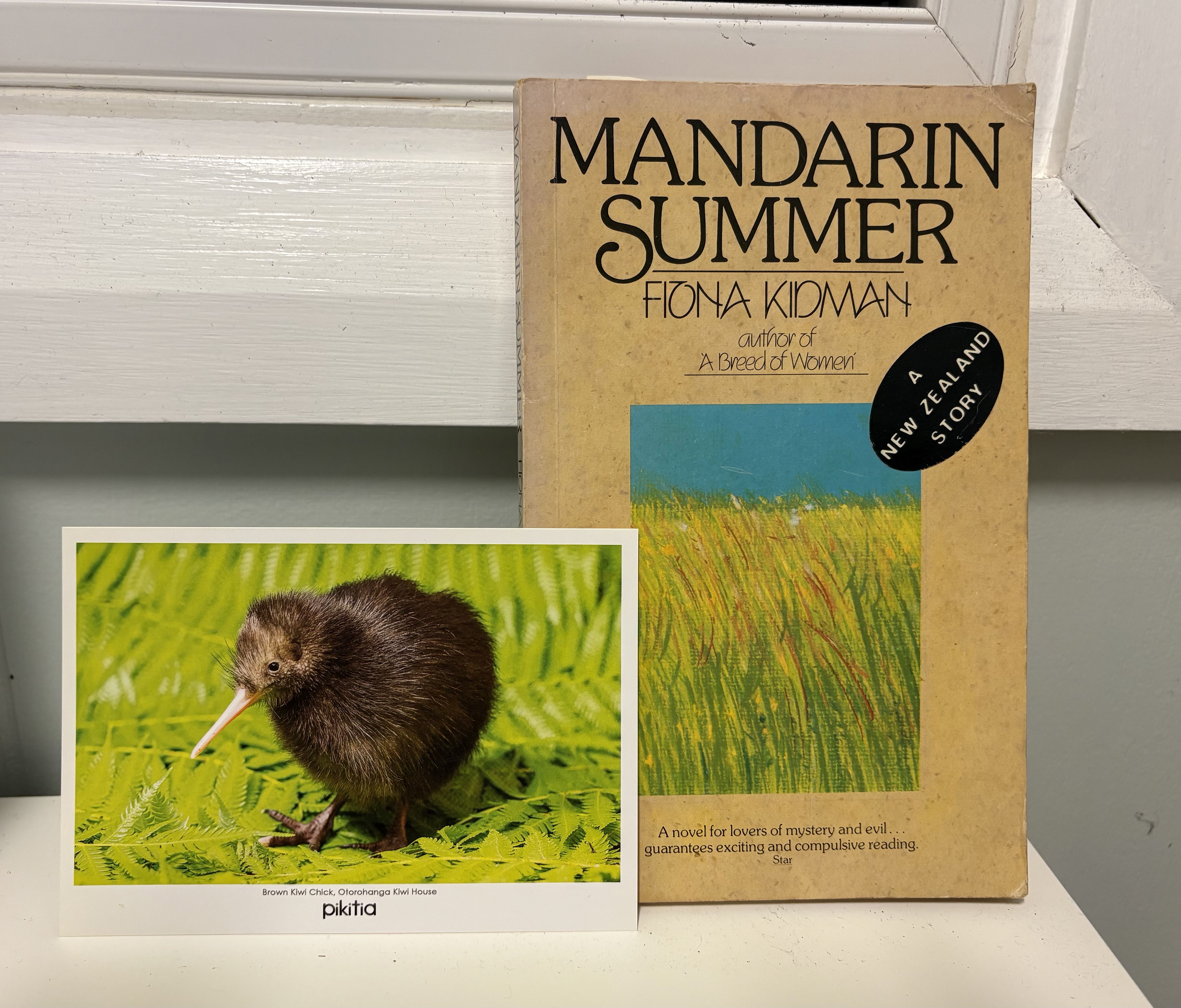
A faded copy of the book Mandarin Summer and a postcard of a Kiwi.

I was delighted to discover that Mandarin Summer is still in print, even though it was never made into a film, as far as I know. It was republished in 2021, and I’m pleased to say that the author, now known as Dame Fiona Kidman, is still writing books and poetry and is a leading figure in the New Zealand book industry. She’s 85 and still going strong.

If you’d like to read my review of a recent ‘coming-of-age’ book, also set in New Zealand, check out BOOK CHAT, my newsletter for readers and eaters.

Should you read the classics?

Should you read the classics?

A friend told me she was trying to read Wuthering Heights but was finding it hard going. I was curious about why she was persevering if it wasn’t her thing. Regular readers know my stance on reading books you aren’t enjoying, but I also understand that people often feel embarrassed if they haven’t read books they think everyone else has, especially if they are classics.

I’m reminded of a scene in a movie where the main character reads Democracy in America (by Alexis de Tocqueville) because she thinks everyone has read it and she feels inferior. It’s only when she’s finished grinding her way through the enormous book and tries to discuss it with her new friends that she finds out no-one else has actually read it. They’re all just pretending and no-one has ever found them out.

And that’s the truth of it. Many people haven’t read Dickens, the Brontës or Jane Austen, and this doesn’t make them any less of a reader, or a person for that matter. My friend definitely doesn’t need to think she doesn’t measure up because she hasn’t read certain books.

To be perfectly honest, I’ve never read Wuthering Heights, but I have seen the movie and the characters always drive me crazy. There are just so dramatic and make totally stupid decisions.

Where to begin?

There’s something to be said for having a crack at something more challenging, but you need to choose carefully. Victorian literature is dense and wordy, so you may need to find a quiet place to really get into the story.

If you’re keen to read one of the classics, but don’t know where to start, I would try Jane Eyre by Charlotte Brontë. It’s a cracking story about an orphan who endures a miserable childhood, then as a young woman gets sent to work in the home of the wealthy and impetuous Edward Rochester. First published in 1847 under the name of Currer Bell, Jane Eyre is a bildungsroman (a coming of age story) that deals with class, sexuality and religion, but it’s also a wonderful love story with a satisfying ending. Along with Pride and Prejudice, and Gone with the Wind, it’s one of the most famous love stories of all time.

The Tenant of Wildfell Hall

Another book I enjoyed is The Tenant of Wildfell Hall by Anne Brontë. Published in 1848 under the name of Acton Bell, it remains remarkably relevant today with its strong feminist themes and portrayal of a woman escaping domestic abuse.

Helen Graham is a beautiful and secretive young woman. She moves into Wildfell Hall with her young son and the locals are desperate to know more about her. A man named Gilbert Markham offers Helen his friendship, but as local gossip and speculation surround her reclusive behavior continue, he wonders if he has misplaced his trust in her.

The shocking details of the disastrous marriage she has left behind emerge when she allows Gilbert to read her diary…

‘A powerful novel of expectation, love, oppression, sin, religion and betrayal’. 

Daily Mail
The Tenant of Wildfell Hall

Middlemarch

A third suggestion is Middlemarch by George Eliot (Mary Ann Evans). It’s a very long book and was originally published in eight instalments. Set in a fictitious town in England in the early 19th century, it tells the story of Dorothea, an intelligent, earnest woman who makes the mistake of marrying Edward Causabon, a man many years her senior. He’s a pompous scholar and bore and his main reason for marrying is to use Dorothea as his personal secretary. Dorothea promptly falls in love with Will Ladislaw, Edward’s idealistic cousin, but tries to remain faithful to her husband, even after his death (silly woman).

I read it many years ago and loved it, but if you really don’t think you can make it through such a long book, look out for TV series (made in 1994) which stars a young and very handsome Rufus Sewell as Will Ladislaw, and Juliet Aubrey as Dorothea.

Why did they use pen-names?

All three novels were published under male pseudonyms, a common practice in Victorian times. Some women wanted to be able to write more freely, others wanted to be taken more seriously. In the case of Eliot, its been suggested that she avoided using her own name because of her elopement with journalist and critic George Henry Lewes, a married man with whom she lived happily for many years.

According to this article, Eliot “relished being thought of as a male and was disappointed when people thought otherwise.” Until Eliot’s first mass publication, The Sad Fortunes of the Reverend Amos Barton in 1957, George Eliot was thought to be male. Eliot was outed in 1958 by a widely circulated letter written by Charles Dickens, who pointed out that the piece was too feminine to be written by a male.

Following Lewe’s death in 1878, Eliot subsequently married her accountant, John Cross and was criticised for this as well. She just couldn’t win!

Want more reading recommendations?

Sign up for Book Chat, a newsletter for readers and eaters.

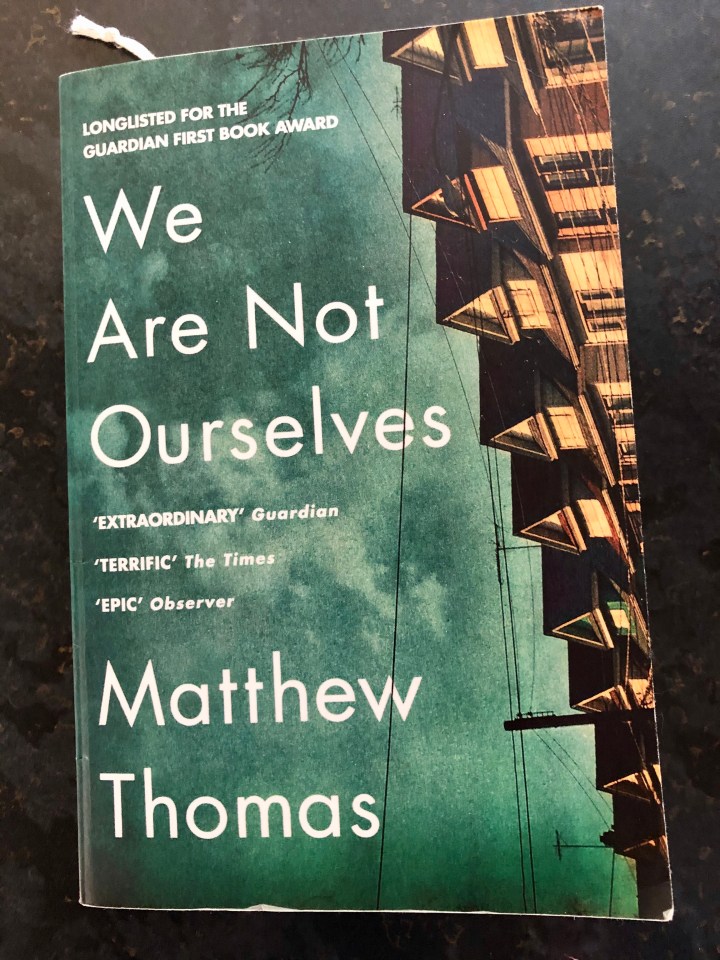
We Are Not Ourselves – book review

We Are Not Ourselves – book review

It’s been a while since I’ve been able to focus long enough to read an entire book.

It’s incredibly hard to concentrate with so much going on in the world and although escaping into a book seems like an easy thing to do, in reality you need to choose exactly the right book in order to be transported into that parallel universe that a good book can provide.

I’ve just finished reading “We Are Not Ourselves” by Matthew Thomas. I put off reading the last chapter because I didn’t want it to end, but I was also a little bit nervous in case it just trailed off. Some novels do that, it’s as though they don’t quite know how to finish. I don’t like endings to be too tidy and twee, but I do like books that give you some sense of things being put right with the world.

It’s a lengthy book (600+ pages) about a marriage between two very different people. Eileen comes from Irish immigrant stock; Ed is a college professor with early onset Alzheimer’s disease. But it’s not just about navigating his illness, it’s about all the ways that relationships evolve over time. It’s about love, death, and birth, and finding compassion for yourself and others. The blurb on the back says that it took the author ten years to write and it’s easy to see the time and effort that went into crafting this novel.

I have a soft spot for books of this kind. You’ll find them frequently in my lists of favourite books and I think this is because I like to know what happens to people as they grow and change. I like to see how people mellow as they age, and how they start to think about things differently. I’m also very partial to books that remind you about what really matters.

At the end of the book, the son reads a letter from his father which says…

When the world is full of giants who dwarf you, when it feels like a struggle just to keep your head up, I want you to remember that there is more to live for than mere achievement. It is worth something to be a good man. It cannot be worth nothing to do the right thing.

Matthew Thomas

Being a good person has value. Good reminder.