
In the early 1990s, I wrote a children’s book called Mr Nobody. It’s a small book, the kind your child might bring home from school in her backpack. Light and flexible, it was designed to be read as homework, or as a quick bedtime story. In Australia, we call these books ‘readers’.
Mr Nobody tells the story of Michael, a small boy of around five or six, who has an invisible friend who looks just like him. I based the story on my little brother’s imaginary friend. He was blamed for anything that went wrong in our house and was also a useful stand-in when my brother was scared or frightened. Mr Nobody never wanted to visit the dentist or have his hair cut.
I was ecstatic when I sold the manuscript for exactly $1000. It was a lot of money in those days, and it made me believe I had what it took to be a children’s author. Sadly, that dream was never realised. I wrote many other stories and articles, but publication eluded me, and I eventually lost heart, choosing to use my creative energy to write essays here on my blog, and then later in Book Chat, my newsletter for readers and eaters.
A few years ago, I was curious to see if my book was still in print, but I couldn’t find the ISBN (International Standard Book Number)) on the huge database which supposedly contains the unique number for every published book in the world. I assumed this meant my book was no longer in print, so thirty years later, I was very surprised to receive a message via social media from a woman in America.
She wanted to let me know her son had borrowed Mr Nobody from his school library.
Unfortunately, she wasn’t writing to tell me how much she loved it.
My child bought home your book Mr No Body (sic) from school. I found your title and your choice to describe a little black boy’s shadow as an ape extremely insensitive. As a well-established author, you are intelligent enough to know exactly why describing a black child’s shadow as an ape is overtly insulting.
Given your age and the generation you grew up in, I am very sure you know exactly why this was unnecessary. If you choose to include black illustrations in your children’s books, at least give us the same respect and dignity you give to others.
Do better.
I was absolutely devastated, but I was also pretty sure she was wrong. I would never have been so insensitive as to describe a black child’s shadow as an ape.
Just to be sure, I searched through my filing cabinet, found my copy of the book, and examined the front cover. Mr Nobody was an exact replica of Michael except that he was depicted as a shadow child. I felt vindicated. How could this woman have even imagined I would describe a small child as an ape? She must have misunderstood.

I wanted to send her a message to let her know she was wrong and that, more importantly, I had not had any say in the way the book was illustrated. Being a white person, I had imagined Michael as sandy haired boy who looked a lot like my brother, but I loved seeing him depicted as a little brown-skinned, curly-haired boy, resplendent in his dinosaur gumboots.
Most of all, I was thrilled that my book was still in print and that someone was describing me as a well-established author, although it made me feel bad that I wasn’t, as if I hadn’t been trying hard enough.
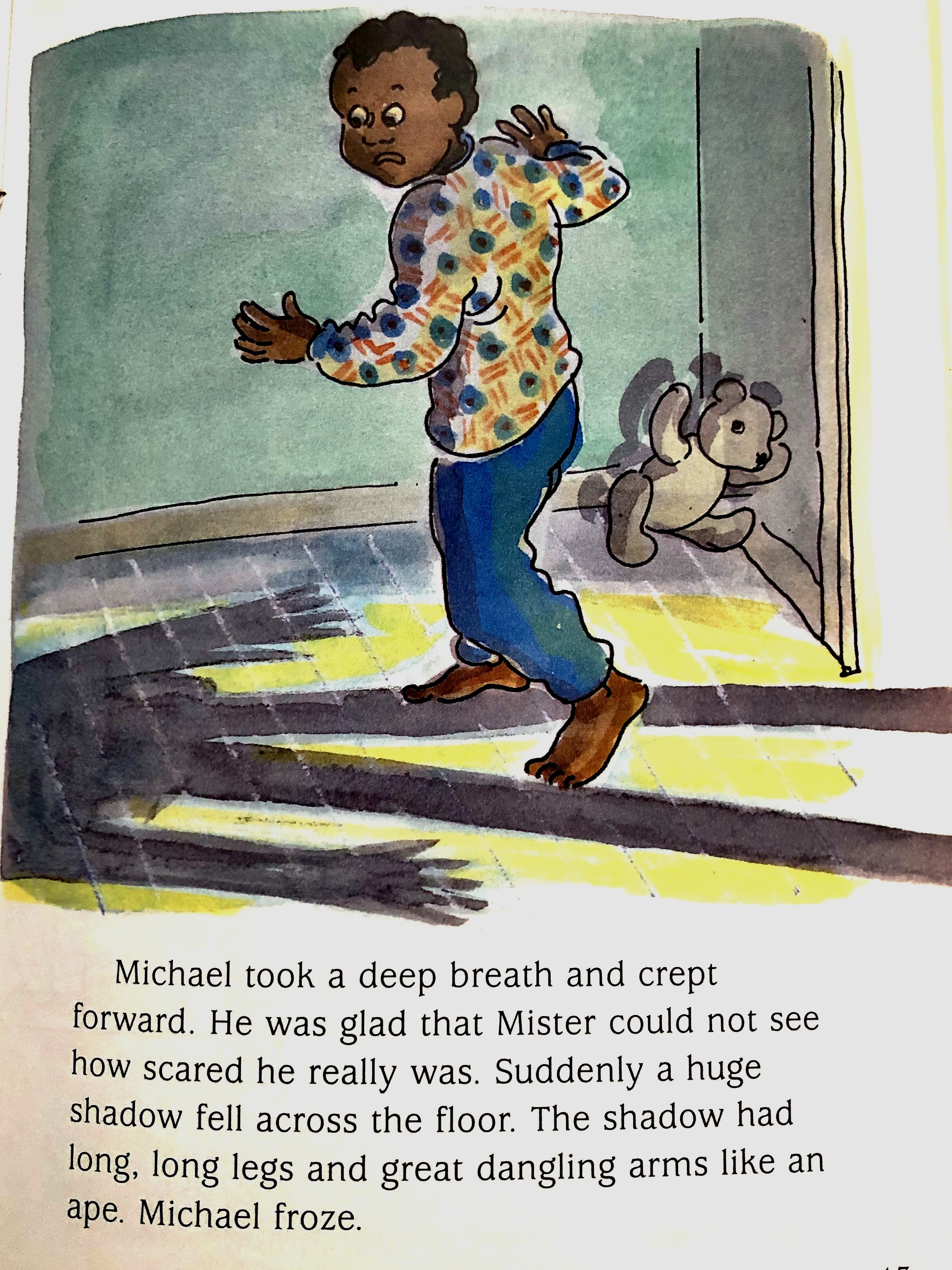
I was still very sure that she had made a mistake, but I went back and read the whole book just in case there was any chance that I had missed something. There’s a scene where Michael is in bed and imagines there’s a monster in the wardrobe. (Spoiler alert – it’s his dog). Michael gets up to investigate while Mister hides under the bedclothes.
“Michael took a deep breath and crept forward. He was glad that Mister could not see how scared he really was. Suddenly a huge shadow fell across the floor. The shadow had long, long legs and great dangling arms like an ape. Michael froze.
‘What are you doing out of bed?’ asked Michael’s dad as he switched on the light. The shadow disappeared.”
Good heavens! I hadn’t described Michael’s shadow as an ape, but I had described his dad’s shadow as an ape, which is equally appalling.
I was surprised and ashamed. I would never have imagined a scenario where I could be accused of racism, and that it would be totally justified.
In 2015 there was a huge furore in Australia when a 13-year-old girl at a football match called one of the players an ape. Adam Goodes, a football star and proud Indigenous man, pointed to the girl and asked for her to be removed from the stadium by security. He later explained to the girl why calling a black person an ape was insulting, and she begrudgingly apologised.
Speaking about the incident later, Goodes said he was absolutely gutted by the insult and felt like he was back at school, where he was frequently the victim of abuse.
But the girl’s mother, who chose to remain anonymous, claimed that he had ‘overreacted’ and that her daughter was traumatised by the event. She said Goodes “shouldn’t take things to heart as much as he does” and that being “badgered” on the football field was part of being a football player.
A media storm resulted. Many people in the community thought that Goodes was being too sensitive, and fans began to boo him incessantly when he took the field. It was clear that many people were unwilling or unable to understand that racism is baked into Australian culture and that racist slurs exist, intentional or otherwise.
Despite support from many people in the community, Goodes took leave from the game he loved and eventually retired from football. He subsequently created The Adam Goodes Foundation, which provides educational opportunities for Indigenous youth and is widely respected in the community.
As the arguments in the media raged on, I counted myself firmly on the side of Adam Goodes, believing that no one, not even a child, has the right to call someone a monkey.
And all that time, I was accidentally sitting in the same camp as people I detested. An accidental racist with nowhere to hide.
To make matters worse, I took the coward’s way out and did not reply to my letter writer.
I could have made excuses for myself. I could have explained that things were different in 1994 and (white) people were not as aware of racial slurs, but I don’t really think that’s true. I think they just didn’t care, and the rest of us just let them get away with it.
I could say that things have changed, but what would I know? I’m fully aware that my life as a middle-class white woman give me practically no insight into what it means to live in the world as a black person.
Over the years I have tried to educate myself by listening to black voices, but I failed to do the one thing I could have done and just said ‘sorry’.
I’m also sad that I can no longer look at my book and feel proud that it made it into the world. It’s still a lovely book with a nice ending, but it feels slightly tarnished.
But mostly I’m sorry that somewhere in the world I made a little boy, and his mum, feel sad and angry.
I guess it’s never too late to apologise, and perhaps I should do just that.
If you enjoyed this post, you might like Book Chat—my fortnightly newsletter where I share book recommendations and simple recipes.
 Margaret Moon
Hi Margaret. This is the third attempt to comment. I’m going to copy this one because the last two disappeared before being sent. I’m not quite sure what I’m doing wrong.
I don’t think you could possibly be accused of racism, accidental or otherwise, if you didn’t choose the illustrations for this little book. The stereotype of a dark-skinned person being compared to an ape is real enough, but it was the illustrator, not you, who chose to make the protagonist and his shadow people of color. Also, the little boy seeing the scary giant shadow in the night as an ape is just the hallucination of a child who himself was black. Still, comparing dark-skinned people to apes is a racist stereotype with a long and egregious history–and none of us would wish to perpetuate it, even if not intentionally.
The girl who called the indigenous soccer player an ape was an example of deliberate, not accidental, racism. Unfortunately, that type of racism is alive in well here in the U.S. too. I thought we were getting past it, what with the civil rights movement, the end of Jim Crow laws, etc., but it seems to be in full flower once again.
I don’t think you should feel shame about this book. It’s too bad it was misread by this person, and perhaps the main character should have been the sandy-haired boy you envisioned rather than a dark-skinned kid, but it sounds like a good story–and it’s still in print! I hope you write another children’s book–or perhaps one for adults!
Thank you so much for persevering and making these thoughtful comments. I must admit I felt very defensive about the whole situation, given that the illustrations were beyond my control. On the other hand, I have listened to people of colour talk about being exhausted by having to deal with everyday racism and I feel for them. I cannot imagine what this must feel like.
Thanks also for your lovely comments on my writing. I am happy to report that I have pulled one of my old children’s stories out of the drawer and will work on it some more. Perhaps I can find a home for it. Like many writers, I get disheartened very easily, so your support is vital.
I believe that people need to remember that social norms have evolved over time. How we expressed ourselves in 1974 was different from how we do it now. There is also an element of the “precious” kind of person who cannot understand and cannot be educated to understand that. I, myself, being of the colour brown, know the insensitivity which came with 1970s, 1980s, 1990s etc. Australia. However, I also grew up reading Enid Blyton’s books and was not damaged by the perceived racism of some of her writing. So, your Mr Nobody, I think, is a valuable and relatable story for kids and should still be in print.
Marie
Hi Marie and thank you for your thoughtful comment. It’s funny you should mention Enid Blyton because I originally wrote a much longer version of this post where I talked at length about her books and her subsequent vilification. People were so outraged about her books, but she never seemed very bothered because, as you say, things change. On the other hand, I think it’s good that casual racism is no longer acceptable.
Thank you so much for sharing this. Your reminder that one can be both well-intentioned and accidentally racist is incredibly important. While I have never written a children’s book, when I look at my own life I can point to moments where I have fallen into stereotypes, perpetuated micro (and macro) aggressions, and simply acted in a way that reflects the racism baked into American culture. In a few cases I have been able to recognize my fault and apologize, but more often than not, I simply have to carry that regret with me and try to do better next time. It is hard, multilayered, and painfully slow work. Thank you for encouraging me and your other readers to take stock of our lives and actions.
Hi Mike! Just wanted to say I really appreciate your comments. It’s lovely of you to take the time to share your thoughts.
Hi my lovely friend. I would like to reiterate the others comments. I was saddened to read what happened and I can see your genuine sadness and concern. I love your writing and the way you have responded. Abi xx.
Thanks Abi. I really appreciate you taking the time to comment. I know that the comment function is a bit clunky, so it means a lot to me.
To be honest, it took me a while to process what happened. I felt so embarrassed but also a bit defensive, given that I had not created the illustrations myself.
Time to move on I guess!
Maybe I will write another book one day… (with no pictures).
There is a question as to why you didn’t have a say so in the illustrations. Why was that, and were you given the chance to see the illustrations before it went into print?
Good question! I sold the rights outright, which meant that they didn’t need to consult me on anything at all. At the time I needed the money and I also assumed that this was the beginning of my writing career, and I could retain the rights to the next book, so I wasn’t very worried about doing it. I slightly regret that now, as it maybe would have earnt some royalties if it’s still in print.
But as a result of my decision, I didn’t see the book until my free copies arrived in the post. I’m pretty sure if you retain the rights, you probably get to see what it looks like before it goes to print, but surprisingly, authors don’t get much of a say on a range of things, including the front cover and sometimes even the title. That’s one of the aspects of self-publishing that writers really enjoy. You get to control everything.
It saddens me you feel your book is slightly tarnished by one remark, which, once again show the power/influence a remark can have. I hope you find a way back to know your book was meant as it is, a delightful read for a child.
Thanks for your kind words. I often see people on Instagram getting dozens of horrible messages and feel very relieved that I’m not famous. I don’t think I could cope.
This is an incredible essay Marg. Wow. I’m just blown away. You wrote it beautifully. I love the title too. I’m sure many many many of us will see ourselves in this story. I hope you widely share this post where you can.
I also love what I see of this story and the book itself, how it was conceived and designed. You are a really talented writer.
Amazing. This was the first thing I read when I woke up today. Val
Valorie Grace Hallinan
Email: vgracehallinan@gmail.com Facebook http://www.facebook.com/ValorieGraceHallinan Goodreads http://www.goodreads.com/author/show/1312717.Valorie_Grace_Hallinan Instagram https://www.instagram.com/valoriegracehallinan/
Books that will change your life @ Books Can Save a Life http://bookscansavealife.com/.
Thanks so much for your kind comments. I really appreciate your support.