Dear reader

Dear reader

I’ve just finished reading a lovely book called Dear Sweet Pea by Julie Murphy. It’s for middle-grade readers (8-12-year-olds), who are ready for novel length books, but not quite ready for young adult fiction, which often has quite strong themes around sexuality, loss, and the difficulties associated with transitioning from childhood to adulthood.

Dear Sweet Pea has all those themes, but they are softened. Body consciousness is dealt with gently, and relationships are all about friendship, rather than romance. It’s an enjoyable read with the main character inadvertently falling into the role of Agony Aunt when she gets involved with an eccentric neighbour who writes an advice column for the local newspaper.

It reminded me very much of a book for grown-ups called Dear Mrs Bird by A J Pearce, which has a similar storyline. Set in war-time England, Emmy (an aspiring war correspondent) takes a low-paid job at a rundown newspaper and begins to secretly answer the letters to Mrs Bird, the resident (and rather fearsome) advice columnist.

Advice columns have always been popular in newspapers and magazines. In the nineteenth century they offered advice on domestic concerns, as well as personal issues like how wives could make themselves indispensable!! They were a good way for women to ask questions about love and about sexual matters in a time when these things were not discussed openly, and doctors were mostly male.

Women have always wanted to know what’s normal and often don’t have anyone they can ask. Some topics are just plain embarrassing and hard to discuss with even your closest friends.

A good place to find the answers to embarrassing questions used to be Dolly Doctor, a column in Dolly magazine, published in Australia from 1970 to 2016. If you want to take a trip down memory lane, back issues of Dolly have been digitised by the National Library of Australia and can be found here.

Another well-known Australian agony aunt was Kate Samperi who wrote a column in the Women’s Day magazine from 1970 to 1993. She gave advice about life, love and happiness in her ‘Dear Kate’ column.

America’s most famous agony aunt was probably Elizabeth Meriwether Gilmer, also known as Dorothy Dix. She was born in 1861 and was the highest paid and most widely read female journalist in the world at the time of her death in 1951. Her advice on marriage was syndicated in newspapers around the world and her name lives on to this day in Australian politics, where a ‘Dorothy Dixer’ refers to the practice of asking a government Minister a planned question during Parliamentary Question Time. This provides an opportunity for a Member of Parliament to either show off or waste time on a matter of little importance.

Modern versions of Dorothy Dix include Dear Sugar, a column originally published anonymously by Cheryl Strayed (author of Wild) and Ask Polly, a column in The Cut magazine, where writer Heather Havrilesky gives no-nonsense advice about a range of issues including how to find new friends, when to break up with your boyfriend and whether you have to thank your aunt when she gives you terrible gifts. Be warned that there is often quite a lot of sweary language (prolific use of the *f* word) in both these columns, but I like their tough love approaches.

I guess there will always be a place for agony aunts in various guises, because despite all the changes in the last 100 years, people are still deeply insecure and in need of reassurance.

I hope you have someone you can talk to, but if not, you can always write to me and I’ll do my best to answer.

You’re never too old for a story book

You’re never too old for a story book

I’ve been reading a lot of children’s books lately. I love the simplicity of the writing and the funny and quirky stories, but mostly I love the illustrations. I am in awe of the work that illustrators do to bring story books to life.

I’m currently enjoying reading Two Bad Teddies by Kilmeny and Deborah Niland, and it struck me that Niland is a very familiar name, but I couldn’t think why.

I thought they might be related to Carmel Niland, former Director-General of the New South Wales (NSW) Department of Community Services, former President of the NSW Anti-Discrimination Board, and founding co-ordinator of the NSW Women’s Co-ordination Unit, but it turns out that Kilmeny and Deborah are (or were) the twin daughters of Ruth Park (author of Poor Man’s Orange) and D’Arcy Niland (author of The Shiralee, a very famous Australian book about a shearer and his four-year-old daughter). What a pedigree!

Sadly, Kilmeny passed away in 2009, shortly after Two Bad Teddies was published. She was a prolific illustrator and artist and published over thirty books. She also painted a portrait of her mother, which hangs in the National Portrait Gallery. You can see it here.

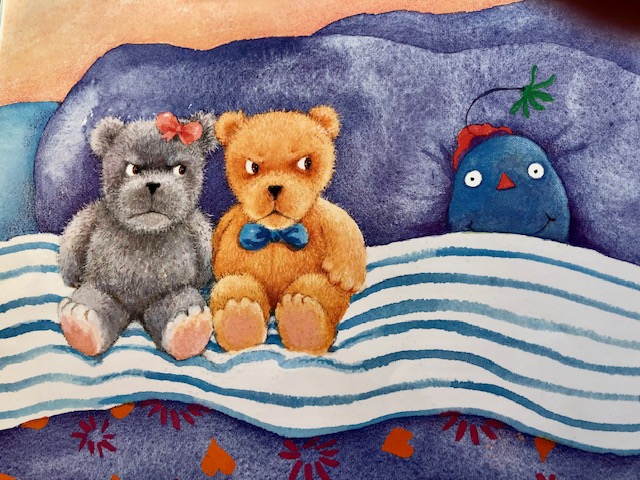
Two Bad Teddies features Tilly and Gruff, a pair of naughty teddies who are jealous of a new soft toy named Bendy Bill. You can just see the displeasure on their faces as their new rival steals away the affections of Mollie-Sue.

Two teddy bears looking grumpy

Like most picture books, the story has a happy ending which I won’t spoil here. I like to read children’s books when I’m feeling down because they make me feel everything will be alright, even if things aren’t great at the moment. They’re a way to escape from reality that doesn’t involve over-eating or drinking too much wine.

So if your life is going a bit pear-shaped, I strongly recommend that you visit your local library or bookshop, and pick up some new books or some old favourites.

In the meantime, look after yourself!

Book Chat!

Book Chat!

Hello friends!

I’m thrilled to announce the launch of BOOK CHAT: a newsletter for readers and writers. If you are a reader or a writer (or both), I’d be really pleased if you signed up. You can do that here. If you’d rather just receive these weekly blog posts, that’s fine as well. I’ll still keep posting here.

People often ask me what I’m reading and how my writing is going, and I thought it would be fun to send out some regular updates on both these topics, along with some of my favourite recipes.

To be honest, it feels rather bold to be launching a newsletter of my own. It seems like something a mildly famous person might do and I’m certainly not that, but I have the time to experiment and I love reading other people’s newsletters, so I thought why not give it a go? I’m sure I’ll make some mistakes along the way, but that’s okay. I heard someone say recently that the only way you can learn is by actually doing something, so I thought it was probably time to stop researching and start taking some action.

I’ve been thinking about failure a lot lately, and especially about why we fear it so much. I’m not sure if it results from toxic work cultures, or whether it’s a by-product of capitalism and rampant individualism (whereby we have to be better than the next person all the time) but I know that an aversion to failure is not conducive to learning. If we don’t fail, we don’t learn.

People say this all the time, but no-one wants to be the person who fails. I know I don’t want to fail, even though I espouse the idea of learning by trying new things.

I’ve spent at least a year thinking about launching a newsletter, and I can honestly say that fear of making a fool of myself has been the main thing holding me back. So here it is – a new experiment. Join me!

cheers

Marg xxx

I want to be like Ramona Quimby

I want to be like Ramona Quimby

I love children’s books, so I was sad to see the passing of the children’s author Beverly Cleary (aged 104) on March 26, 2021. She was one of America’s most successful writers, selling over 91 million books during her lifetime. Her books have been translated into 12 languages and are loved by readers all over the world.

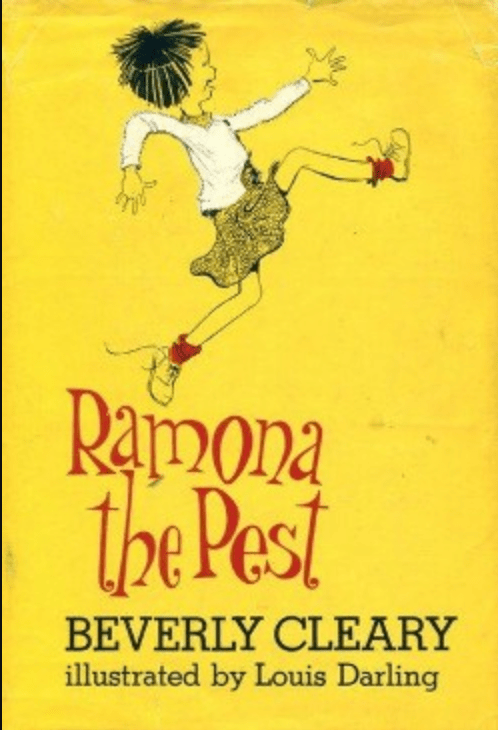
If you aren’t familiar with her work, Cleary was the author of the Ramona books (amongst others), a series of eight humorous children’s novels that center on Ramona Quimby, her family and friends. Her first book, Beezus and Ramona, appeared in 1955 and the final book, Ramona’s World, was published in 1999.

Cleary described Ramona as a feisty girl with no desire to conform, even when pressured by those around her. In Ramona the Pest, when her sister Beezus (real name Beatrice) asks her to stop being a pest, she says…

“I’m not acting like a pest. I’m singing and skipping,” said Ramona, who had only recently learned to skip with both feet. No matter what others said, she never thought she was a pest. The people who called her a pest were always bigger and so they could be unfair.

Ramona went on with her singing and skipping.

From Ramona the Pest by Beverly Cleary

Cleary (whose maiden name was Beverly Bunn), was born in Oregon, the daughter of a farmer and a school-teacher. She trained as a librarian, but didn’t start writing until she was in her thirties. She kept writing well into her eighties (there’s hope for me yet). Cleary said that children kept coming into the library asking for books about ‘children like them’ and there weren’t any, so she decided to write them herself. As a child she was a slow reader and was often sick and absent from school. This seems to be a common theme for a lot of writers. Long periods of time confined to bed must cultivate the imagination!

It’s not possible to calculate the effect that books have on people, but I think that children’s books in particular can really influence how we see ourselves in the world. It’s good to read about characters who look and feel the way you do, especially if you feel like you don’t really feel you fit in. I think this is the reason that I love Ramona. She’s both vulnerable and brave.

Here’s a lovely tribute from journalist Scaachi Koul, born some 20 years after the first Ramona book was published, talking about how the Ramona books affected her life.

Have you read any of her books? Do you have a favourite character?