
In the early 1990s, I wrote a children’s book called Mr Nobody. It’s a small book, the kind your child might bring home from school in her backpack. Light and flexible, it was designed to be read as homework, or as a quick bedtime story. In Australia, we call these books ‘readers’.
Mr Nobody tells the story of Michael, a small boy of around five or six, who has an invisible friend who looks just like him. I based the story on my little brother’s imaginary friend. He was blamed for anything that went wrong in our house and was also a useful stand-in when my brother was scared or frightened. Mr Nobody never wanted to visit the dentist or have his hair cut.
I was ecstatic when I sold the manuscript for exactly $1000. It was a lot of money in those days, and it made me believe I had what it took to be a children’s author. Sadly, that dream was never realised. I wrote many other stories and articles, but publication eluded me, and I eventually lost heart, choosing to use my creative energy to write essays here on my blog, and then later in Book Chat, my newsletter for readers and eaters.
A few years ago, I was curious to see if my book was still in print, but I couldn’t find the ISBN (International Standard Book Number)) on the huge database which supposedly contains the unique number for every published book in the world. I assumed this meant my book was no longer in print, so thirty years later, I was very surprised to receive a message via social media from a woman in America.
She wanted to let me know her son had borrowed Mr Nobody from his school library.
Unfortunately, she wasn’t writing to tell me how much she loved it.
My child bought home your book Mr No Body (sic) from school. I found your title and your choice to describe a little black boy’s shadow as an ape extremely insensitive. As a well-established author, you are intelligent enough to know exactly why describing a black child’s shadow as an ape is overtly insulting.
Given your age and the generation you grew up in, I am very sure you know exactly why this was unnecessary. If you choose to include black illustrations in your children’s books, at least give us the same respect and dignity you give to others.
Do better.
I was absolutely devastated, but I was also pretty sure she was wrong. I would never have been so insensitive as to describe a black child’s shadow as an ape.
Just to be sure, I searched through my filing cabinet, found my copy of the book, and examined the front cover. Mr Nobody was an exact replica of Michael except that he was depicted as a shadow child. I felt vindicated. How could this woman have even imagined I would describe a small child as an ape? She must have misunderstood.

I wanted to send her a message to let her know she was wrong and that, more importantly, I had not had any say in the way the book was illustrated. Being a white person, I had imagined Michael as sandy haired boy who looked a lot like my brother, but I loved seeing him depicted as a little brown-skinned, curly-haired boy, resplendent in his dinosaur gumboots.
Most of all, I was thrilled that my book was still in print and that someone was describing me as a well-established author, although it made me feel bad that I wasn’t, as if I hadn’t been trying hard enough.
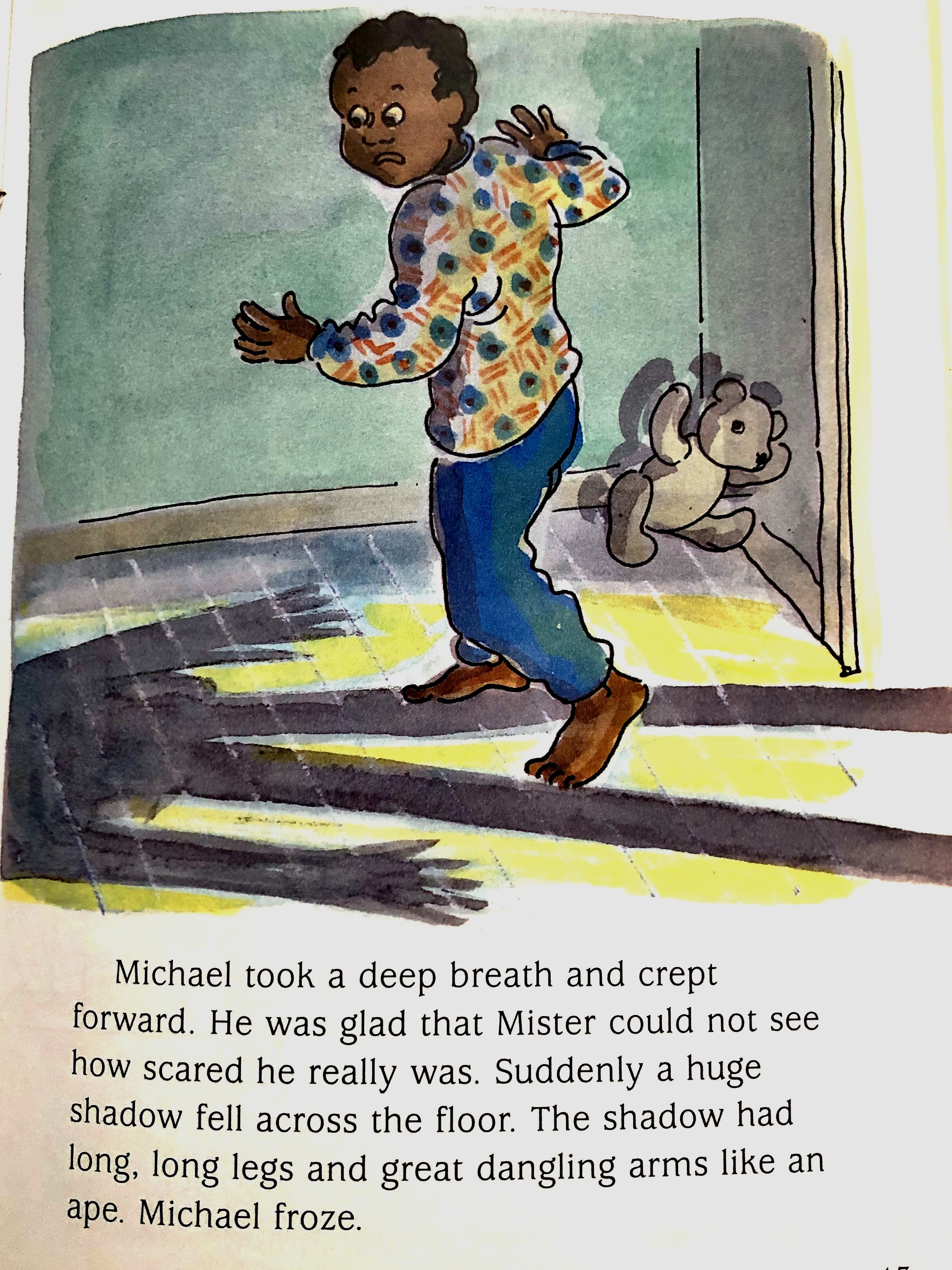
I was still very sure that she had made a mistake, but I went back and read the whole book just in case there was any chance that I had missed something. There’s a scene where Michael is in bed and imagines there’s a monster in the wardrobe. (Spoiler alert – it’s his dog). Michael gets up to investigate while Mister hides under the bedclothes.
“Michael took a deep breath and crept forward. He was glad that Mister could not see how scared he really was. Suddenly a huge shadow fell across the floor. The shadow had long, long legs and great dangling arms like an ape. Michael froze.
‘What are you doing out of bed?’ asked Michael’s dad as he switched on the light. The shadow disappeared.”
Good heavens! I hadn’t described Michael’s shadow as an ape, but I had described his dad’s shadow as an ape, which is equally appalling.
I was surprised and ashamed. I would never have imagined a scenario where I could be accused of racism, and that it would be totally justified.
In 2015 there was a huge furore in Australia when a 13-year-old girl at a football match called one of the players an ape. Adam Goodes, a football star and proud Indigenous man, pointed to the girl and asked for her to be removed from the stadium by security. He later explained to the girl why calling a black person an ape was insulting, and she begrudgingly apologised.
Speaking about the incident later, Goodes said he was absolutely gutted by the insult and felt like he was back at school, where he was frequently the victim of abuse.
But the girl’s mother, who chose to remain anonymous, claimed that he had ‘overreacted’ and that her daughter was traumatised by the event. She said Goodes “shouldn’t take things to heart as much as he does” and that being “badgered” on the football field was part of being a football player.
A media storm resulted. Many people in the community thought that Goodes was being too sensitive, and fans began to boo him incessantly when he took the field. It was clear that many people were unwilling or unable to understand that racism is baked into Australian culture and that racist slurs exist, intentional or otherwise.
Despite support from many people in the community, Goodes took leave from the game he loved and eventually retired from football. He subsequently created The Adam Goodes Foundation, which provides educational opportunities for Indigenous youth and is widely respected in the community.
As the arguments in the media raged on, I counted myself firmly on the side of Adam Goodes, believing that no one, not even a child, has the right to call someone a monkey.
And all that time, I was accidentally sitting in the same camp as people I detested. An accidental racist with nowhere to hide.
To make matters worse, I took the coward’s way out and did not reply to my letter writer.
I could have made excuses for myself. I could have explained that things were different in 1994 and (white) people were not as aware of racial slurs, but I don’t really think that’s true. I think they just didn’t care, and the rest of us just let them get away with it.
I could say that things have changed, but what would I know? I’m fully aware that my life as a middle-class white woman give me practically no insight into what it means to live in the world as a black person.
Over the years I have tried to educate myself by listening to black voices, but I failed to do the one thing I could have done and just said ‘sorry’.
I’m also sad that I can no longer look at my book and feel proud that it made it into the world. It’s still a lovely book with a nice ending, but it feels slightly tarnished.
But mostly I’m sorry that somewhere in the world I made a little boy, and his mum, feel sad and angry.
I guess it’s never too late to apologise, and perhaps I should do just that.
If you enjoyed this post, you might like Book Chat—my fortnightly newsletter where I share book recommendations and simple recipes.
 Margaret Moon