Accidentally racist

Accidentally racist

In the early 1990s, I wrote a childrenโ€™s book called Mr Nobody. Itโ€™s a small book, the kind your child might bring home from school in her backpack. Light and flexible, it was designed to be read as homework, or as a quick bedtime story. In Australia, we call these books โ€˜readersโ€™.

Mr Nobody tells the story of Michael, a small boy of around five or six, who has an invisible friend who looks just like him. I based the story on my little brotherโ€™s imaginary friend. He was blamed for anything that went wrong in our house and was also a useful stand-in when my brother was scared or frightened. Mr Nobody never wanted to visit the dentist or have his hair cut.

I was ecstatic when I sold the manuscript for exactly $1000. It was a lot of money in those days, and it made me believe I had what it took to be a childrenโ€™s author. Sadly, that dream was never realised. I wrote many other stories and articles, but publication eluded me, and I eventually lost heart, choosing to use my creative energy to write essays here on my blog, and then later in Book Chat, my newsletter for readers and eaters.

A few years ago, I was curious to see if my book was still in print, but I couldnโ€™t find the ISBN (International Standard Book Number)) on the huge database which supposedly contains the unique number for every published book in the world. I assumed this meant my book was no longer in print, so thirty years later, I was very surprised to receive a message via social media from a woman in America.

She wanted to let me know her son had borrowed Mr Nobody from his school library.

Unfortunately, she wasnโ€™t writing to tell me how much she loved it.

My child bought home your book Mr No Body (sic) from school. I found your title and your choice to describe a little black boyโ€™s shadow as an ape extremely insensitive. As a well-established author, you are intelligent enough to know exactly why describing a black childโ€™s shadow as an ape is overtly insulting.

Given your age and the generation you grew up in, I am very sure you know exactly why this was unnecessary. If you choose to include black illustrations in your childrenโ€™s books, at least give us the same respect and dignity you give to others.

Do better.

I was absolutely devastated, but I was also pretty sure she was wrong. I would never have been so insensitive as to describe a black childโ€™s shadow as an ape.

Just to be sure, I searched through my filing cabinet, found my copy of the book, and examined the front cover. Mr Nobody was an exact replica of Michael except that he was depicted as a shadow child. I felt vindicated. How could this woman have even imagined I would describe a small child as an ape? She must have misunderstood.

I wanted to send her a message to let her know she was wrong and that, more importantly, I had not had any say in the way the book was illustrated. Being a white person, I had imagined Michael as sandy haired boy who looked a lot like my brother, but I loved seeing him depicted as a little brown-skinned, curly-haired boy, resplendent in his dinosaur gumboots.

Most of all, I was thrilled that my book was still in print and that someone was describing me as a well-established author, although it made me feel bad that I wasnโ€™t, as if I hadnโ€™t been trying hard enough.

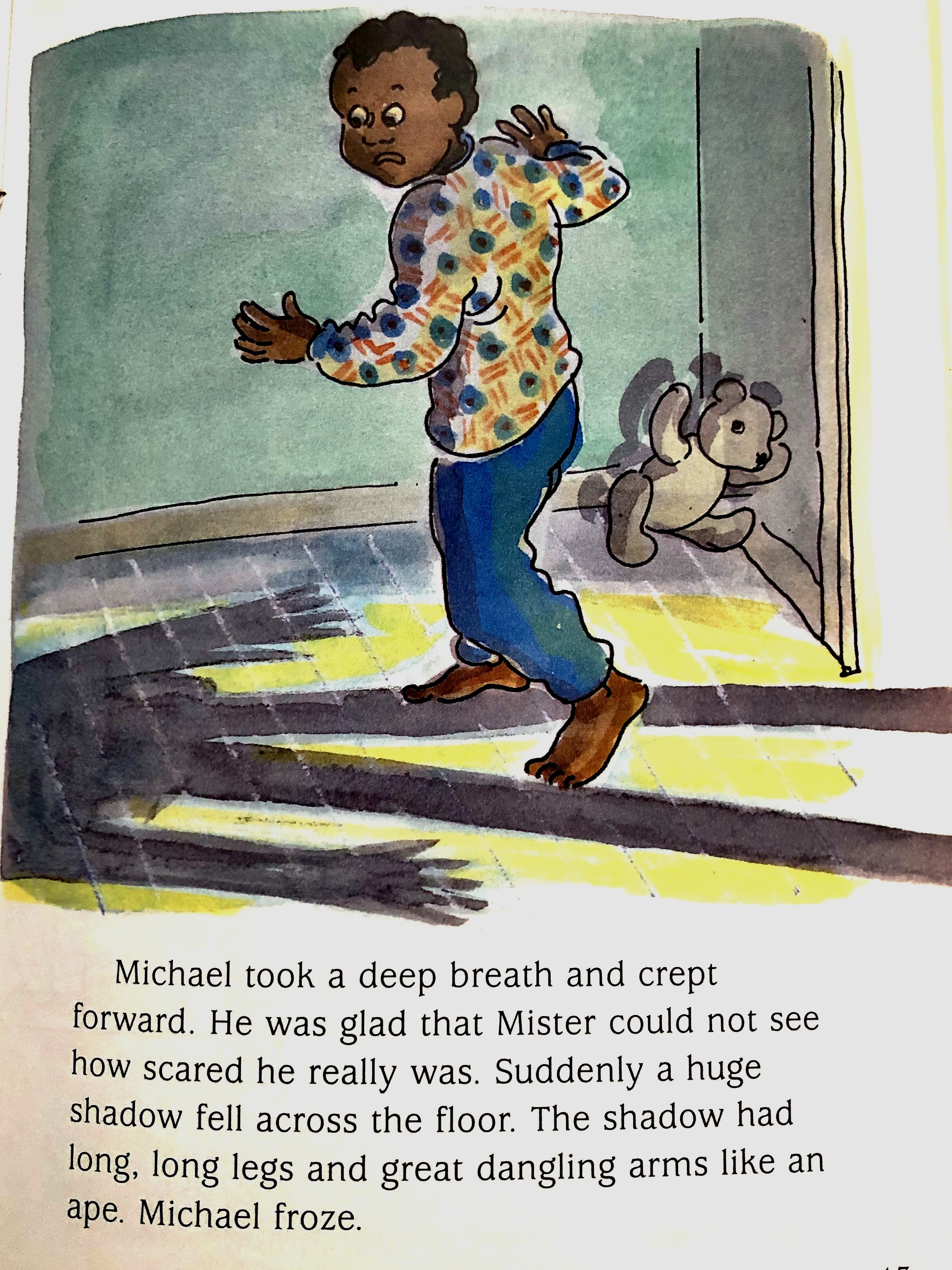
I was still very sure that she had made a mistake, but I went back and read the whole book just in case there was any chance that I had missed something. Thereโ€™s a scene where Michael is in bed and imagines thereโ€™s a monster in the wardrobe. (Spoiler alert – itโ€™s his dog). Michael gets up to investigate while Mister hides under the bedclothes.

โ€œMichael took a deep breath and crept forward. He was glad that Mister could not see how scared he really was. Suddenly a huge shadow fell across the floor. The shadow had long, long legs and great dangling arms like an ape. Michael froze.

โ€˜What are you doing out of bed?โ€™ asked Michaelโ€™s dad as he switched on the light. The shadow disappeared.โ€

Good heavens! I hadnโ€™t described Michaelโ€™s shadow as an ape, but I had described his dadโ€™s shadow as an ape, which is equally appalling.
I was surprised and ashamed. I would never have imagined a scenario where I could be accused of racism, and that it would be totally justified.


In 2015 there was a huge furore in Australia when a 13-year-old girl at a football match called one of the players an ape. Adam Goodes, a football star and proud Indigenous man, pointed to the girl and asked for her to be removed from the stadium by security. He later explained to the girl why calling a black person an ape was insulting, and she begrudgingly apologised.

Speaking about the incident later, Goodes said he was absolutely gutted by the insult and felt like he was back at school, where he was frequently the victim of abuse.

But the girlโ€™s mother, who chose to remain anonymous, claimed that he had โ€˜overreactedโ€™ and that her daughter was traumatised by the event. She said Goodes โ€œshouldnโ€™t take things to heart as much as he doesโ€ and that being โ€œbadgeredโ€ on the football field was part of being a football player.

A media storm resulted. Many people in the community thought that Goodes was being too sensitive, and fans began to boo him incessantly when he took the field. It was clear that many people were unwilling or unable to understand that racism is baked into Australian culture and that racist slurs exist, intentional or otherwise.

Despite support from many people in the community, Goodes took leave from the game he loved and eventually retired from football. He subsequently created The Adam Goodes Foundation, which provides educational opportunities for Indigenous youth and is widely respected in the community.                           


As the arguments in the media raged on, I counted myself firmly on the side of Adam Goodes, believing that no one, not even a child, has the right to call someone a monkey.

And all that time, I was accidentally sitting in the same camp as people I detested. An accidental racist with nowhere to hide.

To make matters worse, I took the cowardโ€™s way out and did not reply to my letter writer.

I could have made excuses for myself. I could have explained that things were different in 1994 and (white) people were not as aware of racial slurs, but I donโ€™t really think thatโ€™s true. I think they just didnโ€™t care, and the rest of us just let them get away with it.

I could say that things have changed, but what would I know?  Iโ€™m fully aware that my life as a middle-class white woman give me practically no insight into what it means to live in the world as a black person.

Over the years I have tried to educate myself by listening to black voices, but I failed to do the one thing I could have done and just said โ€˜sorryโ€™.

Iโ€™m also sad that I can no longer look at my book and feel proud that it made it into the world. Itโ€™s still a lovely book with a nice ending, but it feels slightly tarnished.

But mostly Iโ€™m sorry that somewhere in the world I made a little boy, and his mum, feel sad and angry.

I guess itโ€™s never too late to apologise, and perhaps I should do just that.


If you enjoyed this post, you might like Book Chatโ€”my fortnightly newsletter where I share book recommendations and simple recipes.

The Writer in the Changing Room

I’m excited to share the post I had published on the Brevity blog today.

Guest Blogger's avatarThe Brevity Blog

By Margaret Moon

Trying to become a writer is like trying on lots of new outfits to see what suits you. You start with whatโ€™s fashionable but quickly realise that the skirt is too short for your knobbly old knees and the colour is all wrong for your complexion. No matter how much you squint or look sideways at yourself in the mirror, you canโ€™t take off the forty pounds you gained sitting at a computer writing business reports for the last thirty years and you canโ€™t fool yourself that you look great.

One by one the dresses youโ€™ve taken into the changing room end up on the โ€˜not for meโ€™ rack outside the cubicle, hanging limply with their necklines askew and their sleeves inside out. Clothes that look appealing on the mannequin feel scratchy and uncomfortable. You begin to despair of ever finding a garment that makes you feelโ€ฆ

View original post 454 more words

The elements of style

The elements of style

I spent the morning searching high and low for a postcard I bought in a New York bookshop nearly two years ago. I had chosen it especially for my friend Megan, but hadnโ€™t given it to her, so I thought it would be perfect for her upcoming birthday. Using some clever detective work, I found it nestled between the pages of my copy of The Elements of Style, which I purchased in the same bookshop.

The Elements of Style was first published in 1918 by William Strunk Jr. a professor of English at Cornell University. It was later expanded and updated by his most famous student, EB White. Some of you might recognise EB White as the author of such classics as Charlotteโ€™s Webb and Stuart Little.

Often simply referred to as Strunk and White, itโ€™s a slim little book. The salesperson tried to convince me to buy a facsimile of the original, but I didn’t like the old-fashioned font, so I bought a newer, easy-to-read version. I was delighted to get my very own copy, but until recently, I hadnโ€™t bothered to read it. It was only when I found my missing postcard that I realised that this very short book contains pretty much everything you need to know about writing well.

In chapter two, The Elementary Principles of Composition, it offers the following advice.

  1. Put statements in a positive form. For example, instead of saying “she did not think that the apples were very tasty” say “she thought the apples were sour”.
  2. Use definite, concrete language. Instead of saying “a period of unfavourable weather set in” say “it rained every day for a week”.
  3. Place the emphatic words in a sentence at the end. Writer and editor Allison K Williams also says that you should start sentences with a strong verb and end with a strong noun. “Bring me your dead” is a good example.
  4. And my favourite piece of advice: omit needless words. What can I say?

These suggestions will strengthen your writing, but they all take practice.

Farewell Eric Carle

Farewell Eric Carle

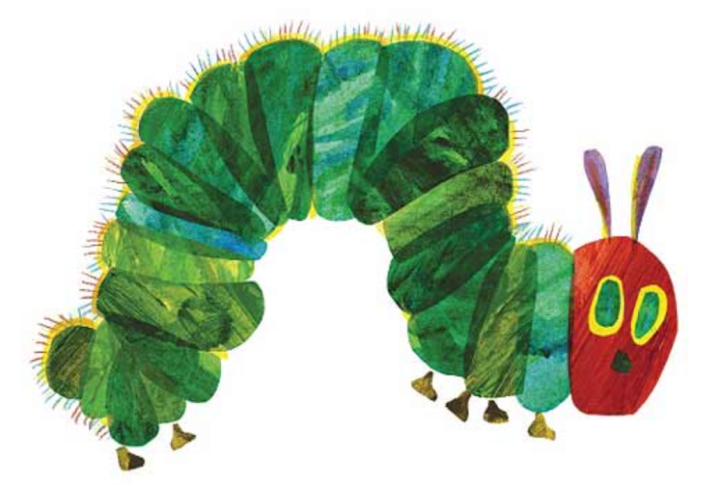
I was looking at the Publisher’s Weekly list of the bestselling children’s books of 2020 last week and noticed that Eric Carle’s book The Very Hungry Caterpillar was number five on the list, so I was sad to read of his passing last Sunday. If you have children, you might have read The Very Hungry Caterpillar once or twice, or perhaps a thousand times, as I have!

I set off in search of my copy and couldn’t find it, which made me sad, although I’m sure it’s around somewhere. Perhaps one of my children has snaffled it?

First published in 1969, the book was an immediate success and has remained on the bestseller list ever since. Over forty million copies have been sold over the last five decades and it’s been translated into 60 languages. The book has enduring appeal thanks to its combination of lovely writing and beguiling pictures. The caterpillar seemed to have an insatiable appetite and you never quite knew what he was going to eat next. Also, kids (and adults) know what it’s like to be VERY hungry and eat anything in front of you, even if you end up with a tummy ache!

My kids loved the fact that you could poke your fingers through the holes in the book. Carle said that he was inspired to write a story about a bookworm when he was using a hole punch one day. Originally entitled “A week with Willie the Worm”, his editor convinced him to change his protagonist to a caterpillar and the rest is history.

Eric Carle sounds like he was a lovely man. In an interview with The New York Times in 1994, Carle said when he was a child, “I always felt I would never grow up and be big and articulate and intelligent. Caterpillar is a book of hope: You, too, can grow up and grow wings.” I love that idea. Who doesn’t want to turn into a beautiful butterfly?

So thank you Eric Carle for writing an excellent book. It has given my family hours of enjoyment and I’m looking forward to reading it again when I find it. If not, I’ll just buy a new copy because thankfully, it’s still in print.

Book Chat!

Book Chat!

Hello friends!

I’m thrilled to announce the launch of BOOK CHAT: a newsletter for readers and writers. If you are a reader or a writer (or both), I’d be really pleased if you signed up. You can do that here. If you’d rather just receive these weekly blog posts, that’s fine as well. I’ll still keep posting here.

People often ask me what I’m reading and how my writing is going, and I thought it would be fun to send out some regular updates on both these topics, along with some of my favourite recipes.

To be honest, it feels rather bold to be launching a newsletter of my own. It seems like something a mildly famous person might do and I’m certainly not that, but I have the time to experiment and I love reading other people’s newsletters, so I thought why not give it a go? I’m sure I’ll make some mistakes along the way, but that’s okay. I heard someone say recently that the only way you can learn is by actually doing something, so I thought it was probably time to stop researching and start taking some action.

I’ve been thinking about failure a lot lately, and especially about why we fear it so much. I’m not sure if it results from toxic work cultures, or whether it’s a by-product of capitalism and rampant individualism (whereby we have to be better than the next person all the time) but I know that an aversion to failure is not conducive to learning. If we don’t fail, we don’t learn.

People say this all the time, but no-one wants to be the person who fails. I know I don’t want to fail, even though I espouse the idea of learning by trying new things.

I’ve spent at least a year thinking about launching a newsletter, and I can honestly say that fear of making a fool of myself has been the main thing holding me back. So here it is – a new experiment. Join me!

cheers

Marg xxx

Using a web editor to improve your writing

Using a web editor to improve your writing

Yesterday I had to get some spelling advice from my sister. Iโ€™d already spent an hour trying to find the answer on the internet, but everything I read just made me more confused, so I gave up and emailed my sister (ex-teacher and librarian), and she replied quick-smart with a definitive answer. Yay for sisters.

I still miss being the go-to grammar and spelling person at work, but to be honest I didnโ€™t always know the answers and often had to look things up on the internet or in one of my trusty books, my favourite being Writing at Work by Neil James, Executive Director of the Plain English Foundation. If you are ever going to buy a writing book, I recommend this one.

Like most people, I have several words which I commonly misspell. (It amuses me that misspelt is a word that nearly everyone misspells). I spent many years with a yellow sticky note stuck on my monitor with โ€œseparateโ€ written on it because I had a mental blank about how to spell it, despite having my spellchecker turned on. Other people tell me they struggle with broccoli, cemetery and when to use stationery/stationary, although that one is easy to remember. A pen is stationery, and we spell both with an e.

Today I read an article where the writer had used pneumonic instead of mnemonic, and it made me laugh. She can blame spellcheck, I guess.

Writing is hard, and everyone makes mistakes, including me.

I recently started using a tool called ProWritingAid, an online editing tool. Itโ€™s not as good as a real editor, (by which I mean a person), but pretty useful. I have the free version which allows you to upload a small quantity of text and it will check it for grammar, spelling and style errors. I also use their Chrome add-on which highlights mistakes when Iโ€™m doing any online writing, for example commenting on other peopleโ€™s blogs. It makes helpful suggestions which you can easily ignore if you donโ€™t like them or donโ€™t agree.

Itโ€™s interesting to observe the mistakes I commonly make and try to correct them. Most of them are poor writing habits such as using passive voice and unnecessary words. Best of all, you get a brief report at the end of the week telling you how many improvements youโ€™ve made.

I have learnt that my main issue is using modifiers that weaken my writing.

Examples are โ€œjustโ€, as in I just wanted to say; โ€œsomewhatโ€, as in I was somewhat discouraged; and โ€œa bitโ€ as in I was a bit sad. We commonly use these words in academic writing, which encourages tentative language. Sentences often start with the words, โ€œthe research showsโ€, or โ€œit would seem thatโ€ฆโ€ You canโ€™t be too confident just in case you canโ€™t back up your claim with evidence.

But Iโ€™m not writing academic essays anymore, so Iโ€™ve started removing these words. As a result, I think my writing is much stronger and clearer. And as you know, I’m a big fan of clarity and brevity.

Why donโ€™t you try it and see what you think?

How stories work

How stories work

โ€œI thought youโ€™d write a book when you retiredโ€ someone remarked recently.

I did too, I think to myself, I just havenโ€™t worked out what itโ€™s going to be about yetโ€ฆ

But the reality is that I really have no idea how to write a book. The advice is to just start writing and see what happens, but this is a scary proposition. Iโ€™m concerned that my efforts will be clumsy or sub-standard, so I donโ€™t do anything at all. Better to have tried and failed is a great adage, but the reality is that no-one really likes failing.

So I was delighted when a friend recommended a book called Story Genius by Lisa Cron. Itโ€™s just what I needed at this point in my writing life because it lays out some foundational skills about how stories work.

Cron says that you should always try to jump into the middle of the action and then fill in the backstory. This helps to set the scene and pique the readerโ€™s curiosity about how the protagonist (main character) got themselves into that situation.

I was thinking about this advice when I read the opening pages of The Sun Down Motel by Simone St. James. The opening is set in a scary motel where a young woman is working alone on the night-desk. She hears a lot of strange noises and next thing you know, sheโ€™s disappeared. Already Iโ€™m filled with curiosity. Why is she working alone in this creepy place which is far away from her home, and what on earth happened to her?

Next we jump forward in time to another young woman arriving at the same motel. Immediately we want to know what sheโ€™s doing there. Is she related to the first young woman? Why is she interested in the disappearance of the first young woman and why now? All this is explained in the first 50 pages, by which time Iโ€™m hooked and want to read the rest of the story.

Cron suggests that stories fail when they are merely a series of events. This happened and then this happened and then this happened. Itโ€™s like you telling me in boring detail how you drove to my house. Quite frankly, I donโ€™t care how you got here, I just care that youโ€™ve arrived safely.

Good stories keep moving you forward because something happens that leads to something else happening. Thereโ€™s a causal relationship between events that connects them and makes sense to the reader. Everything happens for a reason, but sometimes it takes a while for that reason to be revealed.

The authorโ€™s job is to make you wonder what happened and why it happened.

You might think that this is only true of mystery books, but this is not the case. Take the example of Anna Karenina by Leo Tolstoy. After the famous opening lines about happy and unhappy families, we immediately jump into the situation as it stands right now.

Everything was confusion in the Oblonskyโ€™s house. The wife had discovered that the husband was carrying on an intrigue with a French girl, who had been the governess in their family, and she had announced to her husband that she could not go on living in the same house with him.

Leo Tolstoy

Do I want to know more? Why yes, I do.

In his weekly newsletter The Maven Game (which I heartily recommend if youโ€™re an aspiring writer), David Moldawer claims that people are either born with the knack of storytelling or they arenโ€™t. He doesnโ€™t think that itโ€™s something you can teach, but Iโ€™m hoping that heโ€™s wrong and that I can learn to tell a good story.

In the meantime, I’m going to keep reading Lisa Cron’s book and hope that an idea for a book will pop into my head very soon. I’ll keep you posted.

A bunch of nonsense

A bunch of nonsense

I grew up in a house filled with books. To be honest, they were mainly from the library (we visited every week), but the books we did own included a set of encyclopedias, a few well-worn paperback novels, and quite a few childrenโ€™s books, received as gifts from various relatives or as prizes at the Sunday School Anniversary.

Our library included two volumes of poetry, one by A.A. Milne, creator of Winnie the Pooh, and the other a collection of poems by Ogden Nash (1902 โ€“ 1971).

Nash wrote over 500 poems in his lifetime, for both adults and children, and early in his career he was employed as a copywriter for an advertising company. His poems are funny and clever; he had just the right type of temperament for an advertising man.

Here are a few of my favourites:

The Fly

The Lord in His wisdom made the fly, 
And then forgot to tell us why.

The Camel

The Camel has a single hump, 
The dromedary two, 
Or is it just the other way, 
I’m never sure – are you?

Celery

Celery, raw
Develops the jaw,
But celery, stewed,
Is more quietly chewed.

Nash was just 29 when he published his first collection of humorous poems to critical acclaim. The following year he left his job to concentrate fully on writing.

He also wrote the scripts for three MGM films and the lyrics for three Broadway musicals including the hugely successful A Touch of Venus, starring Ava Gardner and Robert Walker about a mannequin who comes to life.

Watching this old clip from reminded me of the 1987 film Mannequin which I have always loved.

Despite being a poet at heart, he still needed to make a living. He sums it up beautifully in this short poem.

Introspective Reflection

I would live all my life in nonchalance and insouciance
Were it not for making a living, which is rather a nouciance.

This is an example of a nonsense poem. Nonsense poems often change the spelling of words to make things rhyme or make them more amusing. They are best read out loud and children usually love them. Other writers of nonsense poems include Lewis Carroll (The Jabberwocky) and Edward Lear (The Owl and the Pussycat).

Do you have any favourite poems from your childhood?

Writing better content

Writing better content

Over the past few months a lot of free courses have been offered on the internet, so Iโ€™ve been madly signing up for things that interest me. These are mainly around writing and using social media, so I’ve got a thousand ideas about things I could do, but of course I’m still nervous about doing anything in case it fails and I look like an idiot.

I’m acutely aware that it doesn’t really matter if things don’t work out, but if you’ve spent a whole lifetime trying to make things perfect (or at least pretty good), then it’s hard to really adopt the idea of sharing a minimum viable product. It doesn’t come easily to put something out there until you’ve double and tripled checked that it looks good and doesn’t have any errors.

But the reality is that even when you check everything carefully, you still make mistakes. It can be incredibly hard to see your own errors, even though it’s pretty easy to spot mistakes in other people’s work. Fortunately, I have an eagle-eyed family who are quick to let me know if I’ve made any major blunders, or even just repeated words which I have a habit of doing.

A few weeks ago I watched an interestingย webinarย on content writing, so I thought I would share some of my key take-aways in case they are relevant to you and your writing,

  1. Manage your time.ย Try to draft your work quickly so that you can spend the bulk of your time on editing and polishing. You can’t edit your words until you’ve got something on the page to work with.
  2. Edit your work but don’t keep polishing it endlessly. Focus on getting it finished. It doesn’t need to be perfect. You can spend a lot of time and energy fiddling around with the wrong thing, for example drafting and re-drafting the first sentence, only to chop it off before you hit send.
  3. Donโ€™t try to impress people with your writing.ย Instead focus on what your post/email/report is trying to say. You should have a clear message, so put your energy into working out what that message is.
  4. Write in your natural voice. I find it very odd when people write in a stuffy, overly wordy way, when this is not the way they usually talk. Write as simply as possible. I promise you that no-one will complain.
  5. Bounce back quickly from mistakes. Make a checklist of your frequent errors and check your work before you publish. Examples might be using one particular word too often. Keep a sticky note on your desk to remind you how to spell any words that you commonly misspell.
  6. Ask someone else to read your draft. As I mentioned earlier, it can be almost impossible to see your own errors. Ask a trusted friend or colleague to check your work.
  7. Try leaving your work to marinate overnight. Sometimes the right words just jump into your brain when you stop thinking so hard. If possible, leave your work as a draft and come back to it the next day. You will usually be able spot any errors or fluffy bits straight away.

Thank you for reading my blog. If you like it, please share this post with a friend or colleague.

And if you see any errors, please let me know.

One thing you can do to improve your writing

One thing you can do to improve your writing

A few weeks before I started my long leave, I was walking past a coffee shop on my way to work and I had an overwhelming desire to go in and order scrambled eggs and a large flat white and just sit outside in the sunshine watching the world go by.

It seemed like a much better option that going into the office and facing a barrage of emails and work requests, and it was at that precise moment that I realised that I was really a bit over going to work.

Every Monday morning I would sit at my desk and feel slightly overwhelmed at the big โ€œto doโ€ list in front of me, especially since many of the tasks seemed to be the same things that Iโ€™d been doing for the last few years, with very little impact.

I started to realise that perhaps I was just going around in circles, preaching the same sermon about the need to simplify projects, systems and services to a mostly deaf audience.

No matter how many times I tried to say that we were making things too complicated, it seemed that there was a strong desire for wordy inaccessible documents and for reports so obscure and protracted that only the most enthusiastic reader would ever make it to the end.

Making things simple and understandable has been my whole lifeโ€™s work and in reality, itโ€™s been a failure. People like things to be complicated. It looks impressive. It makes you seem smart.

Itโ€™s bad for the community, but really, who cares? Apart from the community of course.

Recently, my friend Sue sent me a link to the new strategic plan for our local Council. She had bravely tried to read it (and make sense of it) and was despairing about the poor writing, overuse of trendy meaningless terms and general inaccessibility of the document. It was obvious that although the stated purpose of releasing the draft document was to encourage โ€œcommunity consultationโ€ it was written in a way that clearly prevented this.

We had an interesting conversation about whether these documents are written with the intention of being deliberately obscure, or whether the tendency to write like this is driven by ignorance, or just people thinking that this is what you are supposed to do. A combination of one or all of these I suspect.

My friend highlighted the extensive use of โ€˜weasel wordsโ€™ (words that people use when they are trying to avoid telling the truth) and also sent me a link to the awesome bullshit generator which I love for its awfulness.

The tool is designed to generate bullshit for your next meeting, proposal or interview with your boss. You press the button and out comes a stream of unintelligible, meaningless phrases that sound oh so impressive but mean absolutely nothing. Whatโ€™s really alarming is that Iโ€™ve actually seen some of these phrases used quite recently.

I know that writing is hard for many people. The rules of grammar are sometimes confusing and inconsistent, and many people feel daunted by the prospect of writing long documents.

But thereโ€™s one thing that you can do to improve your writing straight away.

Donโ€™t try to sound impressive, just try to be clear.

Donโ€™t fuss about your writing style. Donโ€™t try to sound smart. Just say what you want to say.

Often when people write very wordy documents, I ask them to tell me (out loud) what they are trying to say. Unsurprisingly, they are often able to articulate that very clearly. Then I say, just write that down. What you just said was clear and concise, so just say that. It’s easier than you think.